A testing automation framework is an overall system in which the tests will be designed, created, and implemented. It also includes the physical structures used for test creation and implementation and the logical interactions among those components.
If a group of testers is working on the same or different project and each tester is applying their own strategy to automate the application under test, then the possibility of duplication is higher. Also, the time taken to understand the whole strategy will be high. So we need an environment that should be independent of the application and has the capability to scale as per the application under test. For this purpose, we use a testing Framework.
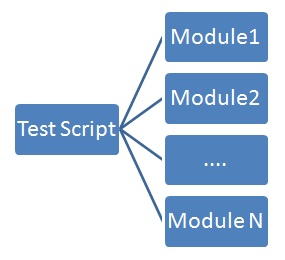
The module is a small independent script that performs a specific set of tasks. It creates a layer in front of the component and hides the components from non-technical users as well as applications. The small components are added up to build a large test set.
In a Data-driven framework, test input and output values are read from data pools, DB sources, CSV files, Excel files, DAO objects, ADO objects, etc. Navigation through the program, reading the data files, and logging test status information are all coded in the test script.
The keyword-driven framework requires the development of data tables and keywords that are independent of the test automation tool used to execute them and the test script code that “drives” the application under test and the data. Keyword-driven tests look very similar to manual test cases. In a keyword-driven test, the functionality of the application-under-test is documented in a table as well as in step-by-step instructions for each test.
There are 2 basic components in Keyword Driven Framework viz. Keyword, Application Map.
The keyword is an Action that can be performed on a GUI Component. Ex. for GUI Component Textbox, some keywords (action) would be InputText, VerifyValue, VerifyProperty, and so on.
An Application Map provides Named References for GUI Components. Application Maps are nothing but ‘Object Repository’.
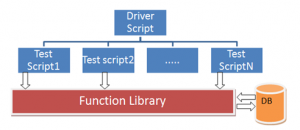
The most commonly implemented framework is the best combination of all the techniques. It combines Keyword-driven, modular, and Data-Driven frameworks. The hybrid Testing Framework allows data-driven scripts to take advantage of the powerful libraries and utilities that usually accompany a keyword-driven architecture. The framework utilities can make the data-driven scripts more compact and less prone to failure. Tests are fully scripted in a Hybrid Testing Framework thus increasing the automation effort. Hybrid Testing Framework also implements extensive error and unexpected Windows handling. It is used for the automation of medium to large applications with long shelf life.
Advantages of Hybrid Testing Framework:
Have questions? Contact the software testing experts at InApp to learn more.