The demand for web applications has increased in 2021. Moreover, businesses expect better user experience, user-friendliness, and advanced features from web application development.
To meet rising expectations and demands, developers have to be innovative to bring the best framework to the table. For most of them, Node.JS frameworks are the first choice for web application development. Approximately 80% of back-end and full-stack developers rated Node.JS as their go-to choice.
The popularity of the Node.JS frameworks has resulted in a large and active community of programmers. They’re introducing new frameworks frequently with varied features. From such a large pool, it can become difficult to select the best node framework for your web application development requirements. You’ll have to decide based on whether you need development freedom or support automation.
InApp has a lot of experience in working on Node.JS frameworks for web application development. Here we introduce you to some of the best Node frameworks available in the market in 2021. Let’s start with the basics.
Node.JS is a cross-platform runtime and open-source environment for executing JavaScript code on the server or outside of a browser. There is an ongoing debate about whether Node.JS is a framework, but we’ll call it one. There are three types of Node.JS frameworks: Full-Stack MVC, MVC, and REST API frameworks.
Node.JS is popular among developers for the following reasons…
The benefits of Node.JS frameworks include…
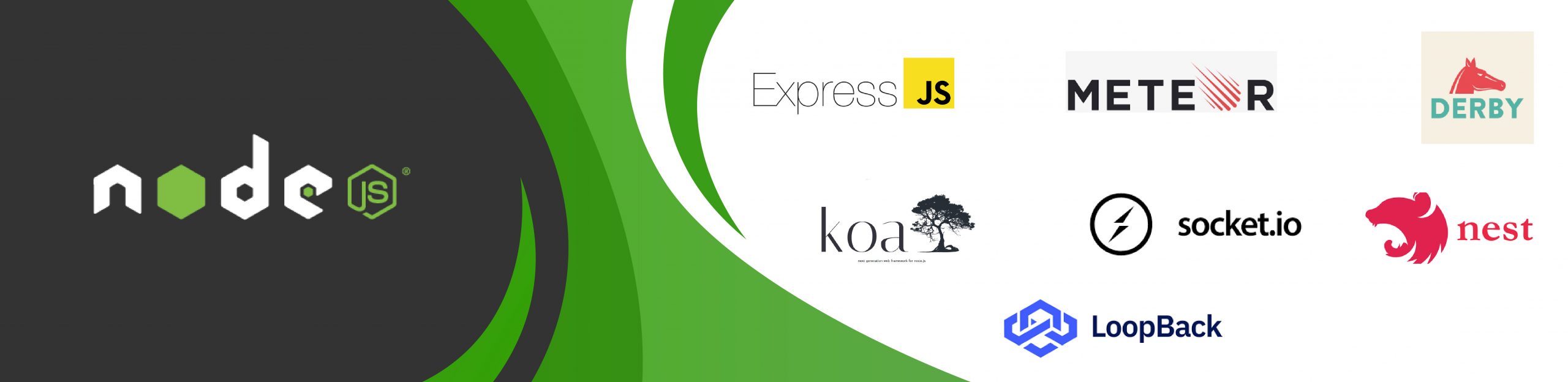
One of the most popular frameworks, the Express.JS framework is flexible with a minimalistic approach. It’s an easy-to-use framework for coding architecture. However, you’ll need to have basic development skills to leverage them for web application development.
An open-source web application development framework, Meteror.JS allows data alterations without the involvement of developers. If you’re comfortable with JavaScript, Meteror.JS is an excellent choice.
Derby.JS is a full-stack, open-source framework. It is used for building real-time web development applications. It’s best used for creating APIs and collective apps.
Derby.JS allows users to build fast-loading, real-time web apps. It’s flexible and extensible, and it’s also compatible with almost all browsers and provides seamless data transfer between server and client.
Koa.js helps developers build APIs easily by efficiently dealing with HTTP middleware through a stack-like technique. With this framework at hand, your business can successfully maintain different forms of content representations via the same URL such as owning different image formats, page translations, etc.
Famous among developers for accuracy and a faster development process, Socket.IO is used for producing real-time computing apps. It has a straightforward API. Some companies using Socket.IO are Alibaba Travels, Trello, Plaid, Patreon, and Justmop.
Primarily based on Angular.JS, Nest.JS is a server-side app framework created for supporting developer productivity. Developers prefer it for building scalable and robust server-side apps. It works on the basic principles of functional programming and object-oriented programming, combined with Typescript integration. It’s used by ClearGlass, Quero, Content Square, SalesHandy, and OneFit.
LoopBack.JS is a full-stack Node.js framework. It provides the connecting link between the client and the server. It’s good for creating server-side APIs with a dynamic API explorer and an easy-to-use CLI. It’s used by IBM, GoDaddy Sapient, AN10, Chiper, etc.
The use of Node.JS guarantees quick deployment and easy scalability. Also, it offers easy development for a minimum viable product (MVP).
Although we’ve focused on the top seven Node.JS frameworks in this blog, many others are available in the market. They can be used for varied purposes such as web application development, mobile app development, chatbots, APIs, and games.
For answers to your questions about what Node.JS framework suits your business needs, please contact us.
Referred to as a framework, Node.JS is a run-time environment for creating web applications that allow developers to run JavaScript apps outside of the browser.
There’re many Node.JS frameworks available in the market. Your requirements will determine what’s best for you. InApp listed our top seven frameworks in this blog.
Some of the benefits of Node.JS include…
Among many, alternatives include Python, PHP, Java, Scala, Haskell, Go, etc.