Many organizations are keen to adopt AI, but very few are truly ready for it. While the focus is often on AI models and automation, the real challenge usually lies in legacy software systems, disconnected data, and limited integration capabilities that prevent AI initiatives from scaling beyond pilot projects and delivering real business value.
In this blog, we explore why software modernization has become a basic requirement for AI readiness and how legacy systems continue to limit enterprise AI success.
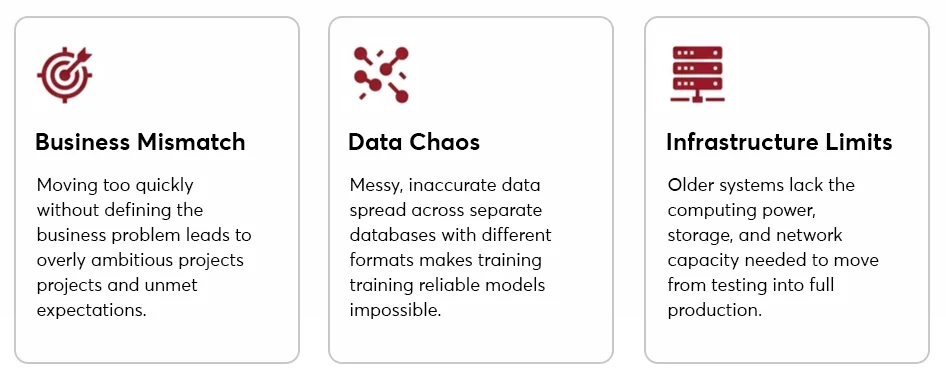
In real-world settings, AI projects often fail because of three main technical issues.
Enterprise IT modernization helps solve four major problems that often stop AI projects from succeeding:
Even successful pilot projects can meet significant bottlenecks when scaling. Performance often drops sharply from testing to real-world use, leading organizations to abandon the project. This gap between pilot and production is one of the main reasons enterprise AI projects fail.

Systems for Environmental, Health, Safety, and Quality (EHSQ), as well as asset, facility, and maintenance management, need especially strong foundations for AI. These platforms handle important safety data, so if AI fails, the results can be serious. For example, a bad AI recommendation in an EHSQ system could lead to compliance issues, safety problems, or environmental harm.
In these scenarios, it is important to have a clear corrective action plan. This should include technical steps for fixing and retraining AI models, process changes to make systems easier to track, and accountability and oversight rules. Organizations also need to set up safety measures to prevent AI from making risky decisions without confidence, so humans remain in control of crucial operations.
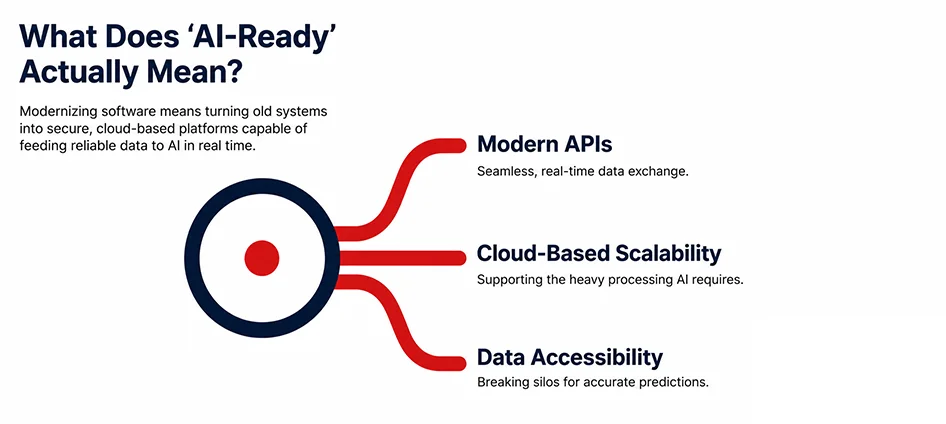
AI-ready software has certain features that make it easy to add AI. Modern APIs help systems and AI services work together and share data in real time. Cloud-based systems that can scale with AI need support for the heavy processing AI requires. Enhanced data accessibility breaks down information silos, enabling AI systems to access the detailed datasets they need to produce accurate predictions.
Modernizing software means turning old systems into secure, cloud-based platforms. This gives AI systems access to good data and strong security. The modernization process also introduces version control, automated testing, and continuous integration practices that support the iterative nature of AI development.
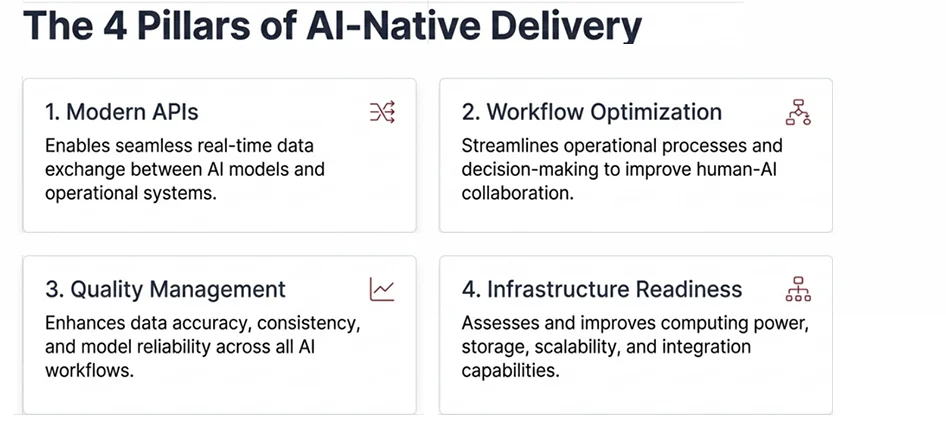
Modernizing legacy systems allows for AI-native delivery in several ways, including:
Together, these capabilities create a robust foundation for scalable AI adoption. They also help organizations move AI initiatives from isolated pilots to reliable, enterprise-wide deployment.
Modernizing legacy systems while preparing for AI integration is a challenging process that often exceeds the capabilities of internal teams. That is why organizations should consider partnering with teams that have documented success in the industry.
InApp’s AI Readiness Sprint is a good example of this approach. The InApp AI-readiness sprint is a fixed-scope strategic engagement designed to help businesses plan AI adoption more quickly and effectively.
Step 1 – The sprint identifies the challenges not only in shifting AI-readiness governance but also assesses if the business is AI-ready in terms of talent and technology, and suggests technological changes needed to enable AI.
Step 2- The team helps identify low-risk/high-impact starting points for AI adoption, minimizing the risk of failure and ensuring AI investments deliver high-value outcomes.
Step 3- The team offers a tailor-made implementation proposal with detailed scope, phases, and timelines. The proposal would include a framework for modernizing data pipelines, quality controls, and AI compliance.
The success of AI depends on more than advanced models. Without modern infrastructure, connected data systems, and scalable architecture, most AI initiatives struggle to scale beyond pilots.
As AI adoption increases, software modernization becomes a key foundation for long-term AI readiness. Organizations that modernize early will be better positioned to deploy AI effectively, reduce risk, and achieve sustainable business value.
The three main obstacles are a mismatch between solutions and problems, poor data quality, and not having the right infrastructure to support AI projects.
Updating software helps organizations create the systems, ability to grow, and easy access to data needed to support AI effectively. Without modern systems, AI projects often have trouble growing beyond small tests.
Many AI projects fail due to bad data quality, unclear business goals, not having the right systems ready, and difficulties in scaling AI from pilot environments to enterprise-wide deployment.
Modernizing systems helps organizations improve data flow, scale up their infrastructure, work more efficiently, and connect different systems. This makes it easier to use AI reliably across the business.