Healthcare systems operate 24/7. Emergency rooms remain active all night, patient queries continue beyond working hours, and healthcare professionals often manage increasing workloads under time-sensitive conditions.
As patient expectations continue to grow and healthcare systems become more complex, hospitals and care providers are seeking ways to improve responsiveness without overburdening medical staff.
This is where Artificial Intelligence (AI) plays a significant role. From virtual health assistants to predictive patient monitoring, AI is helping healthcare organizations provide faster, more accessible, and more continuous patient support.
In this blog, we will look at how AI is making round-the-clock patient support possible in today’s healthcare and why it’s becoming a key part of patient care going forward.
Healthcare does not operate within fixed working hours. Patients may require medical assistance, appointment information, emergency guidance, or prescription support at any time of the day.
However, maintaining continuous patient engagement can be tedious. Increasing administrative workloads, patient volumes, and limited staff availability often make it difficult to consistently deliver timely support.
At the same time, patients want faster responses, easier access to information, and more convenient online options. Because of this, healthcare organizations are turning to technology to work more efficiently and ensure patient satisfaction.
AI-powered healthcare support systems are emerging as key solutions that help healthcare providers address these challenges and offer more responsive, continuous patient care.
AI helps healthcare organizations support patients by automating recurring tasks, helping staff, and allowing faster access to information and services. Here are some of the most useful ways AI is being used to support healthcare:
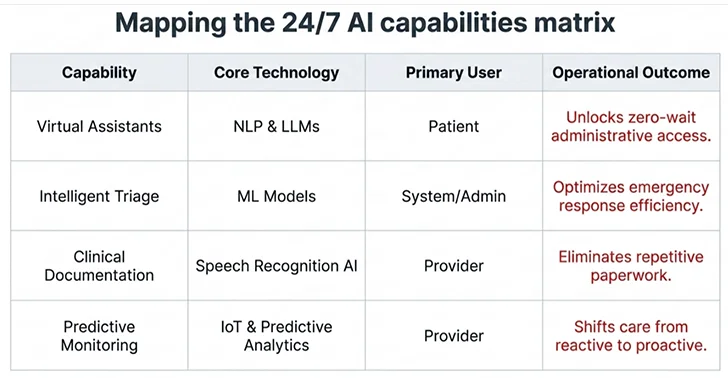
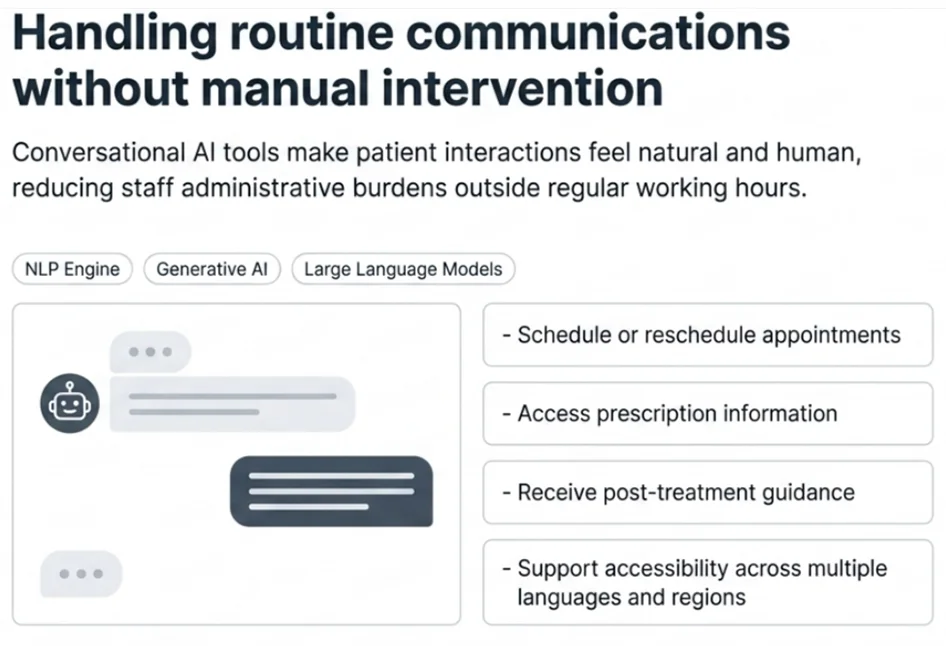
AI-powered virtual assistants are used by healthcare providers to handle routine patient communications, including appointment scheduling, medication reminders, responses to common healthcare questions, and basic guidance.
Additionally, conversational AI tools like Natural Language Processing (NLP), Generative AI, and Large Language Models are used to make patient communications on websites, apps, and support systems feel more natural and human.
For example, more healthcare providers use AI-powered virtual assistants, such as Microsoft Healthcare Bot, and solutions built with Dialogflow and Amazon Lex to automate routine patient tasks.
These systems can help patients to:
Some organizations also integrate multilingual AI assistants that improve patient accessibility across languages and regions.
These tools help healthcare providers respond more quickly and reduce staff administrative burden, especially outside regular working hours.
AI-powered triage systems help healthcare providers prioritize patient cases based on urgency, symptoms, and medical history. With Machine Learning (ML) models and predictive analytics, these systems can analyze patient-reported symptoms and identify cases that may require immediate medical attention. This helps hospitals improve emergency response efficiency and maximize patient routing during high-demand situations.
For example, healthcare organizations are rapidly integrating AI-assisted triage platforms with symptom-checking systems and predictive analytics tools to:
Rather than replacing medical judgment, these systems function as decision-support tools that help healthcare professionals respond more effectively and reduce delays in patient care.
Documentation is one of the most time-consuming administrative tasks in healthcare environments. AI-powered documentation tools are helping healthcare providers simplify clinical workflows through voice-to-text transcription, automated note generation, and intelligent record management.
Several healthcare organizations are adopting platforms such as Nuance Dragon Medical One and AI-powered electronic health record systems to reduce repetitive paperwork and improve workflows.
These tools use speech recognition AI, NLP-based summarization, and healthcare workflow automation to:
By reducing manual documentation, doctors and nurses can spend more time on patient care rather than on repetitive administrative tasks.
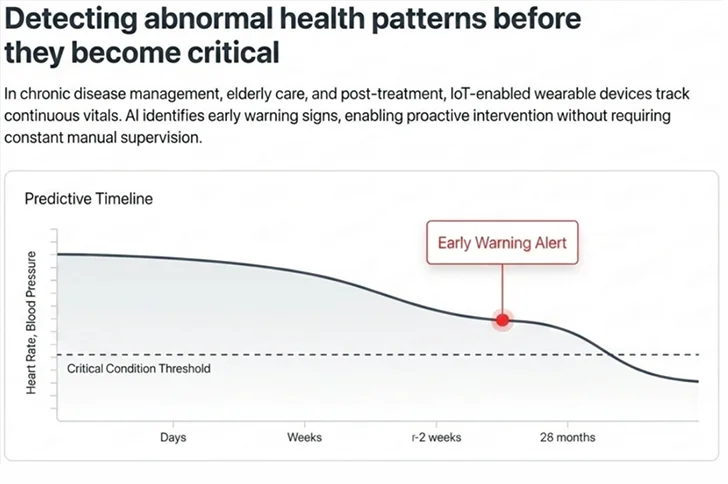
AI also supports continuous patient monitoring by identifying patterns and detecting early warning signs from patient data and medical history.
With predictive analytics, IoT-enabled healthcare devices, and AI-driven monitoring systems, healthcare providers can monitor patient conditions in near real-time and identify potential health risks earlier.
For example:
In remote healthcare and post-treatment care, these technologies help healthcare providers maintain continuous patient engagement without requiring constant manual supervision. This improves both patient safety and operational efficiency while enabling more proactive healthcare support.
AI-powered patient monitoring is also becoming more common through wearable healthcare devices and remote monitoring platforms.
Smart health wearables, IoT-enabled monitoring systems, and AI-powered analytics platforms can continuously monitor patient vitals such as heart rate, oxygen levels, blood pressure, and sleep patterns.
For example, remote patient monitoring solutions integrated with AI analytics enable early detection of abnormal patterns and support proactive intervention before conditions become critical. This is particularly valuable in chronic disease management, elderly care, and post-treatment patient monitoring scenarios.
Although AI enhances healthcare support systems in many ways, it still poses several limitations and challenges.
While implementing AI, healthcare organizations need to ensure patient data remains private, comply with regulations, and verify that AI recommendations are accurate, especially when handling sensitive information or making big decisions.
In addition, successful AI adoption requires proper integration with existing healthcare workflows, continuous monitoring, and human oversight to ensure that the technology supports healthcare professionals as intended.
As AI continues to evolve, maintaining the balance between automation, patient safety, and human judgment will remain essential.
AI is becoming an important part of how modern healthcare systems deliver continuous and responsive patient support. From virtual health assistants and intelligent triage systems to predictive monitoring and AI-assisted documentation, healthcare organizations are increasingly using AI to improve operational efficiency and patient experiences.
As patient expectations continue to grow, AI-powered support systems can help healthcare providers build more scalable, connected, and patient-focused care experiences. Rather than replacing healthcare professionals, AI helps reduce administrative burden, improve accessibility, and support faster decision-making across healthcare environments.
The healthcare future may not be fully automated, but it will likely be increasingly AI-assisted, helping healthcare providers deliver better support around the clock.