If a radiologist reviews a CT scan once and misses something important, mock jurors say they are negligent 65% of the time. With a second review, that number drops to 43%. But when AI is involved, the question becomes more complicated: who is responsible when the algorithm makes a mistake?
AI is now used to help with medical decisions. For example, doctors use AI to read chest X-rays and suggest treatments. While AI can improve care and save time, it also creates a big challenge: determining who is responsible when an AI recommendation harms a patient.
AI accountability focuses on determining who should be held responsible when an AI system leads to a medical error. The key challenge with AI models is that they operate as “black boxes,” meaning even the developers and clinicians using them may not fully understand how a specific decision was reached.
Usually, medical responsibility depends on who has control, makes judgments, and makes decisions. But AI adds a new layer of difficulty. Clinicians might rely on AI advice without having control over how the system comes up with those results.
This creates multiple key challenges, including:
With AI becoming part of everyday medical workflows, the next question is how existing legal standards apply. Currently, courts do not treat AI as an independent decision-maker. Instead, responsibility is usually assessed by how healthcare professionals, organizations, and developers handle the technology.
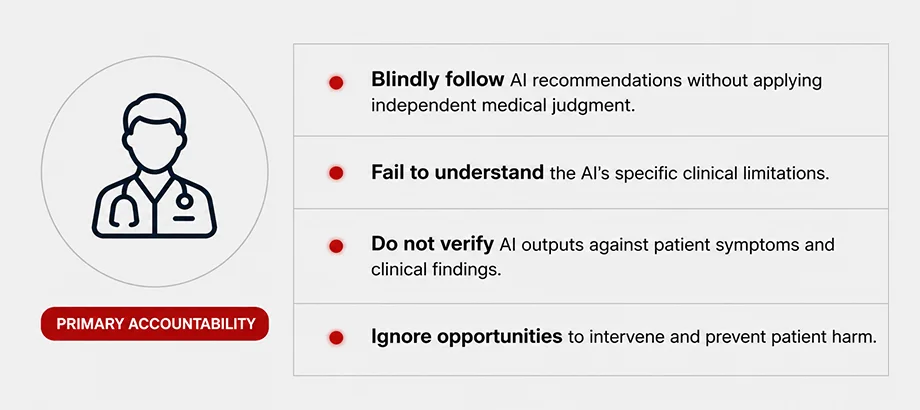
In most cases, Clinicians remain the primary party held accountable. However, hospitals and AI developers may also face liability depending on how the system was implemented and managed.
Clinicians have a non-negotiable duty towards patients and simply cannot transfer their responsibility to an AI system. Physicians may face liability when they:
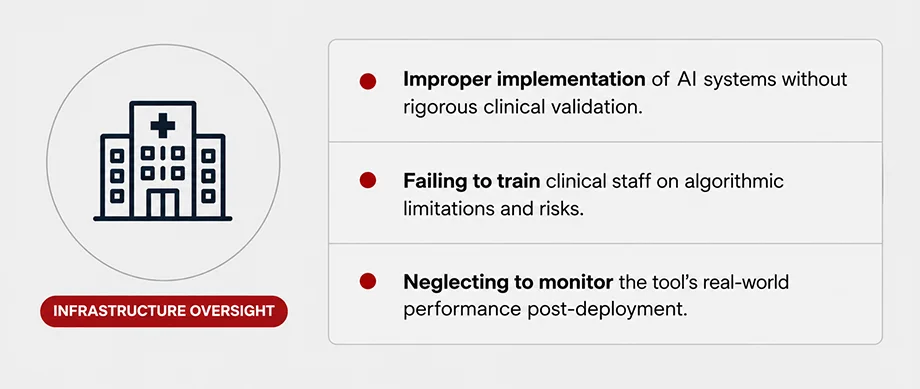
While clinicians are responsible for their decisions, healthcare organizations also play a major part in ensuring AI is used safely. Hospitals must choose suitable tools, train staff, and monitor performance after deployment. If not, they may face liability for:
In some cases, developers who contributed to the AI system may also face legal exposure. However, proving developer negligence can be challenging because of the complexity of AI systems and limited visibility into how models operate. Developers may face liability when:
Since AI affects patient safety, privacy, and medical decisions, regulators are creating new rules to control its use. These rules aim to balance innovation with accountability while ensuring that healthcare organizations maintain proper oversight.
Regulatory agencies oversee healthcare AI in multiple ways, including approving devices, protecting privacy, and setting health IT rules.
FDA Regulation:
Other Federal Requirements:
As federal guidance continues to evolve, states are also introducing their own AI regulations that focus on transparency, responsible use, and the prevention of algorithmic bias. Requirements include:
Regulations for AI use in healthcare are growing worldwide. The EU AI Act classifies AI-enabled medical devices as high-risk systems and requires stronger controls around transparency, oversight, and data governance. The systems must include:
As AI takes on a larger role in diagnosing and treating patients, how healthcare organizations handle and oversee these systems will play a bigger role than the technology itself. Organizations need to set up proper AI governance, confirm that tools work for particular patient groups, train healthcare workers to understand what AI can and cannot do, keep detailed records of oversight, and check how systems are performing.
In the end, organizations that value openness, human supervision, and ethical AI practices will be in a stronger position to manage risks, tackle issues of responsibility, and earn trust in AI-driven healthcare solutions.
Responsibility usually depends on how the AI system was used. Doctors, hospitals, and AI developers may all share responsibility based on their part in making decisions, putting the system in place, and supervising it.
No. AI is seen as a tool to help, not as a doctor making decisions on its own. Doctors are still responsible for using their own judgment and checking the AI’s advice.
AI systems can be complicated and hard to understand, especially when they use advanced learning methods. This makes it hard to tell if a problem came from the algorithm, the data, or how the system was used.
Yes. Hospitals can be responsible if they use AI tools that are not reliable, do not train their staff well, or do not keep track of the system after it is put in place.
By validating AI tools, training clinicians, creating governance policies, monitoring performance, and maintaining clear documentation of AI use, healthcare organizations can reduce risks.