How organizations move from using AI as a tool to letting AI reshape the way they work, and why the difference is everything.
Boardroom conversations are different now. The question is no longer if AI should be used, but how deeply it should be integrated. Many companies are testing AI tools and seeing small boosts in productivity. Still, a gap is opening between those who just add AI to existing processes and those who rebuild their operations with AI at the center. Understanding your organization’s position and future direction may be the most important decision you make this decade.
As organizations become more experienced with AI, they usually move through three different operating models. These are not just steps in adoption, but represent different beliefs about the purpose of AI.
In the AI-enabled model, teams can choose to use AI tools. These tools help speed up tasks like writing emails, summarizing meetings, or generating simple code. But the main workflow remains unchanged, roles stay specialized, and teams still depend on each other. Success is measured by how much time people save each week.
It is important to note that there is no major change in structure, no new standards for evidence, and no shift in how work is broken down or reviewed. As a result, the impact is limited, and the benefits are only minor.
AI-augmented organizations take things a step further. They employ tools like GitHub Copilot and Cursor throughout their work, and teams begin to develop habits and patterns for using them. Still, the overall process remains the same, with requirements moving through design, development, testing, and deployment as separate stages, each with many handoffs.
AI-augmented systems rely on AI as a helpful tool, speeding up existing processes without questioning whether those processes are still the best way to work. Output increases, and some prompt templates are created, but there is still no common standard for specifications. The basic unit of work is still the task. The value is moderate, and most changes are just in the tools used.
AI-Native is a completely different approach. It describes organizations that build intelligence within their core, rather than just adding AI to their legacy systems. This is the difference between being AI-enabled and being truly defined by AI.
In this model, the usual phases of work overlap. Work is broken down into small, outcome-focused units that AI can handle. Specifications not only explain what to build, but also why, who it is for, the limits involved, and how to check if it works as intended. While the team guides the results and manages risks, AI handles technical details.
In this case, success is measured by how quickly teams learn, the quality of reviews, and the business results achieved at every step, not just by the code written or the tasks completed.
AI-Native products are built from the ground up with AI as a crucial part. Without the AI, the product would not work. This distinction determines whether organizations achieve 10x transformation or 10% incremental improvement.
Adopting an AI-Native model offers a category of benefits. These are not marginal improvements; they are structural.
McKinsey’s 2025 survey of 1,400 technology companies found that AI-Native products generated 2.6x faster revenue growth than AI-enhanced alternatives in the same market categories.
AI-Native delivery does not create instant results. Organizations expecting rapid transformation without the right discipline often struggle to see real impact.
One of the most misunderstood shifts in AI-Native delivery is the evolution of roles. AI does not eliminate roles; it reshapes them around outcomes.
In traditional teams, we usually see work passed between different people: business analysts write requirements, developers write code, testers check for bugs, and engineers handle deployment. Each role has a separate job with a clear handoff.
In an AI-Native model, we don’t need these handoffs as much. This isn’t because we are getting rid of people, but because the nature of our work changes, where these steps now happen together.
That is, the business analysts’ role shifts to designing intent. Instead of writing user requirements for developers, they now create specifications that AI tools can use. They break features into small, AI-ready parts with clear evidence requirements, manage the mapping from features to specs, and ensure AI output matches intent, not just syntax. They also maintain reusable instruction sets that capture domain expertise and company knowledge.
The developers’ role shifts to enabling delivery. They are responsible for the quality of specifications, setting standards for evidence, and guiding how AI is used. This does not replace technical leads. Instead, it helps teams adjust to the new way of working, supports developers with AI tasks, and sets up agreements so teams can work well without always needing outside help.
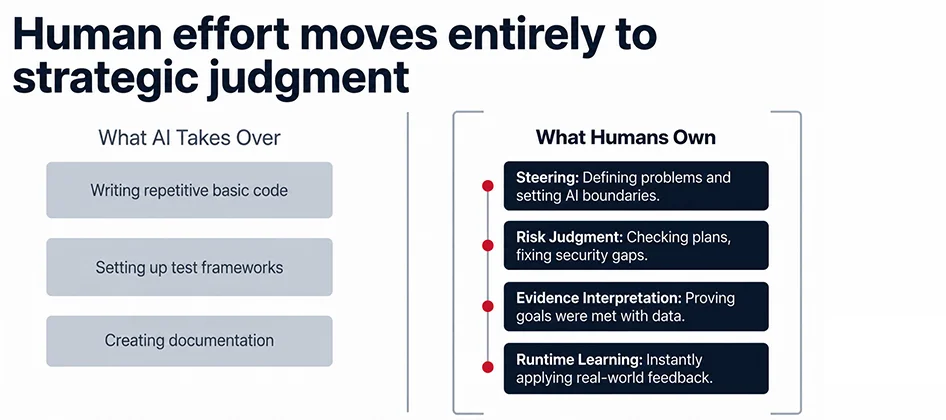
In an AI-Native model, teams stop spending time on work that AI handles more reliably, quickly, and at scale. Tasks such as writing repetitive basic code, setting up test frameworks, and creating documentation move over to the AI. What humans own is:
The judgment-intensive, ambiguity-resolving, stakeholder-navigating work that teams do best becomes the entire job, rather than a fraction of it.
Gartner predicts that 80% of organizations will evolve large software engineering teams into smaller, AI-augmented teams by 2030. This is no distant projection. The restructuring remains visible today in organizations that have moved beyond the AI-Enabled phase.
Adopting an AI-Native operating model impacts every layer of an organization. Leaders who see it as just a software upgrade, rather than a structural change, risk missing the deeper shift needed to fully unlock AI’s potential.
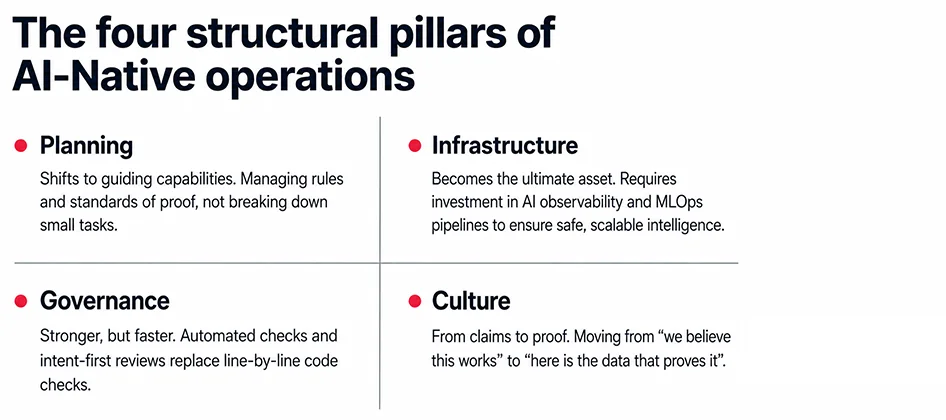
AI-Native is not just about adopting better tools. It means redesigning how work is planned, executed, and validated with AI as a core collaborator.
The organizations that succeed will not be the ones with the most AI licenses, but those with clear rules, strong feedback loops, and teams focused on intent over process. This shift requires clearer goals, stronger accountability, and evolving roles. For organizations ready to adapt, the impact goes beyond efficiency, driving faster delivery, better quality, stronger traceability, and long-term competitive advantage.