Software delivery has become a competitive advantage. Every delayed release means slower innovation, delayed customer value, and missed business opportunities. Whether launching a new feature, responding to customer feedback, or addressing a security issue, organizations need a faster and more reliable way to deliver software.
A CI/CD pipeline helps organizations automate repetitive development and release tasks. This makes software delivery faster, more predictable, and easier to manage. The result is faster innovation, greater operational efficiency, and a more reliable customer experience.
In this blog, we will look at how organizations can build their first CI/CD pipeline and what to consider when creating a scalable software delivery process.
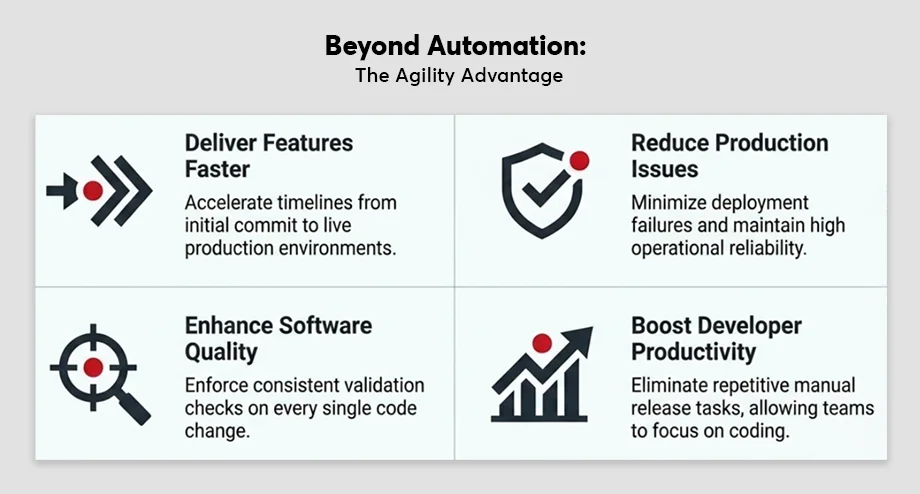
While automation is a key benefit, the real value of CI/CD lies in improving business agility, reducing operational risk, and enabling teams to deliver software with greater confidence.
A well-designed pipeline helps organizations:
When organizations release software more often, having a repeatable delivery process is necessary for keeping both speed and quality high.
The first step is to understand the current software delivery process and identify where manual work causes delays or errors. Many organizations begin by automating repetitive activities such as building applications, testing software, and deploying releases.
A successful implementation should include:
Instead of automating everything at once, many organizations get better results by starting with one application or business area. This approach lets teams improve their process before rolling out automation more widely.
The goal is not simply to deploy software faster, but to create a delivery process that is reliable, repeatable, and easy to scale.
As software delivery becomes more automated, security and governance should be integrated into every stage of the process rather than treated as a final checkpoint.
Organizations should ensure that only authorized users can make deployment decisions, confidential data is securely managed, and every software release adheres to consistent quality and compliance standards.
Security should be embedded throughout the software delivery lifecycle. Regular security checks, continuous monitoring, and proactive risk management help identify issues early, reduce operational risk, and improve release confidence.
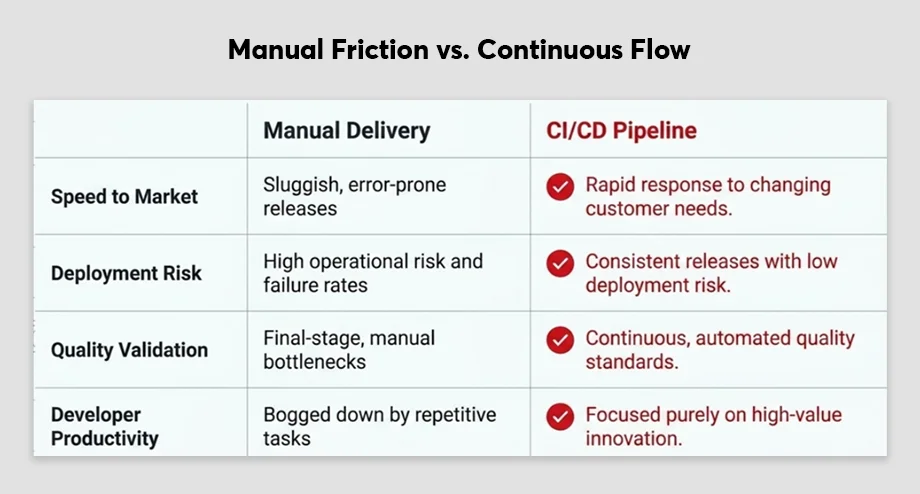
Adopting CI/CD is as much about improving processes as implementing automation. Organizations often face challenges when existing development practices differ across teams or rely heavily on manual workflows.
Common challenges include:
These challenges can be addressed by standardizing delivery processes, monitoring software releases, reviewing changes before deployment, and establishing recovery plans that minimize business disruption if problems occur.
A successful CI/CD strategy focuses not only on automation but also on creating consistent processes that improve dependability over time.
Building a CI/CD pipeline is an important step toward creating a faster, more resilient software delivery process. By reducing manual work, improving release consistency, and strengthening quality controls, organizations can accelerate innovation whilst lowering operational risk.
As software becomes increasingly central to business growth, a well-designed CI/CD pipeline provides the foundation for delivering new capabilities with greater confidence, speed, and predictability.
A CI/CD pipeline lets organizations deliver software faster with less manual work and lower deployment risk. It makes releases more consistent, improves software quality, and helps teams react quickly to changing customer and business needs.
Along with faster software delivery, a CI/CD pipeline boosts efficiency, reduces production issues, improves developer productivity, and makes release cycles more predictable. These benefits let organizations innovate quickly while keeping quality and reliability high.
Begin by finding manual bottlenecks in your software delivery process and automate the most repetitive tasks first. Roll out CI/CD step by step, starting with one application or business area, so teams can improve their process before expanding it to the whole organization.
Some common challenges are different processes across teams, manual approvals that slow down releases, not enough insight into software quality, and too little testing. To tackle these, standardize workflows, improve governance, and monitor delivery performance.
Build security into every step of the delivery process. Set up access controls, protect sensitive data, run regular security checks, monitor pipeline activity, and establish clear quality standards to reduce both operational and security risks.