Artificial intelligence (AI) continues to be technology’s hot topic, growing exponentially in recent years. Many of the recent breakthroughs are the result of deep learning frameworks, where an app learns skills from an annotated dataset during training cycles. Also called machine learning, the framework applies this new knowledge to process new data.
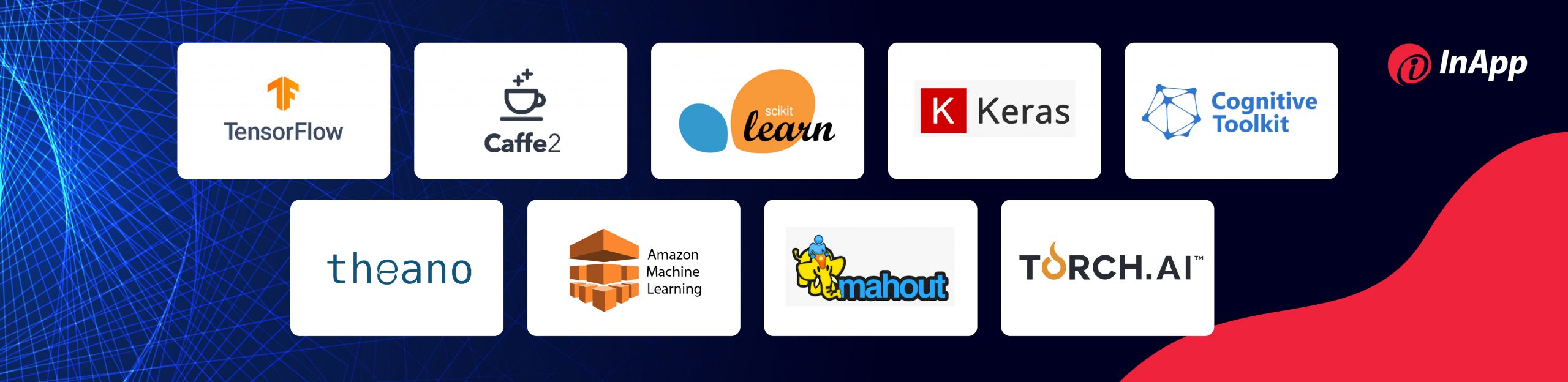
When it comes to AI, you can choose from many different deep learning frameworks, depending on your needs. We’ll discuss some of the major ones in this blog, and outline each framework’s pros and cons.
Developed by Google, TensorFlow provides a robust, open-source framework that supports deep learning. TensorFlow can be used in many programming languages, notably Python, Javascript, C++, and Java.
This open-source framework is capable of high computational power, and it can run on different CPUs or GPUs. That flexibility offers benefits for many different types of applications.
Developed at the University of California, Berkeley, Caffe (Convolutional Architecture for Fast Feature Embedding) supports different types of deep learning architectures for image classification and segmentation. It is written in C++, with a Python interface.
Caffe includes a preloaded set of trained neural networks, making it particularly useful for tight deadlines. This open-source deep learning framework is being used in academic research projects, startup prototypes, and even large-scale industrial applications in vision, speech, and multimedia.
As the most used library in Python for data mining and data analysis, Scikit Learn provides a general-purpose machine learning framework designed for supervised and unsupervised machine learning algorithms. It’s a community effort, and anyone can contribute to it.
Scikit Learn offers a selection of efficient tools for machine learning and statistical modeling including classification, regression, clustering, and dimensionality reduction via a consistent interface in Python. The framework is built on top of several popular Python packages such as NumPy, SciPy, and matplotlib, each responsible for lower-level data science tasks.
Because of its ease of use and focus on user experience, Keras is the deep learning solution of choice for many university courses. Keras also includes backend support for Tensorflow, Theano, CNTK, and more.
Keras is used by scientific organizations around the world. It offers low-level flexibility to implement arbitrary research ideas with optional high-level convenience features to speed up experimentation cycles.
CNTK, the Microsoft Cognitive Toolkit, is a framework for deep learning. A computational network defines the function to be learned as a directed graph where each leaf node consists of an input value or parameter, and each non-leaf node represents a matrix or tensor operation upon its children.
This open-source framework supports text, message, and voice remodeling. Microsoft CNTK provides an efficient scaling environment due to a faster overall evaluation of the machine models. It’s the leading choice for applications like Skype, Cortana, etc.
Using GPUs in place of CPU, this framework supports deep learning research and is capable of delivering accuracy for networks that need high computational power like multi-dimensional arrays. Theano is based on Python, which provides faster processing and response.
This framework already has existing user bases in AWS, S3, and Amazon Redshift. This is a managed service by Amazon with data analysis, training of the model, and evaluation.
Apache Mahout assists with the development of scalable machine-learning frameworks. It doesn’t deal with APIs as such, but it helps in the implementation of new machine-learning algorithms by data scientists and engineers.
Torch is an open-source framework that supports numerical operations. It offers numerous algorithms for the faster development of deep learning networks. It is used extensively in the AI labs of Facebook and Twitter.
TensorFlow is an open-source framework developed by Google researchers to run machine learning, deep learning, and other statistical and predictive analytics workloads. It’s designed to streamline the process of developing and executing advanced analytics applications for users such as data scientists, statisticians, and predictive modelers.
An Artificial Intelligence framework allows for the easier and faster creation of artificial intelligence applications. These include machine learning, deep learning, neural networks, and natural language processing solutions.
An AI model is a program or algorithm that uses data to recognize certain patterns. This allows the model to reach a conclusion or make a prediction when provided with sufficient information. Types of Artificial Intelligence models include: