Starting something new is always an adventure, especially when it involves navigating the exciting yet often complex world of Data Science and AI. My own journey in establishing a Data Science/AI Center of Excellence (CoE) at InApp has been a whirlwind of learning, building, and transforming. Many are embarking on this journey, and I wanted to share some insights from my experience to help others on their path.
Building a CoE from the ground up is not just about technology. It is about understanding people, processes, and possibilities. When I was hired to establish InApp’s first Data Science CoE, I knew this would be more than just hiring data scientists and buying software. It would be about creating a foundation for our organization’s AI-driven future.
When I first stepped into this role, the canvas was essentially blank. I didn’t spend my first few months writing code or building models. Instead, I became a student of the company. This meant diving deep into our business, getting to know our clients, and assessing where we stood in terms of data and AI readiness. I understood our company culture, our risk appetite, and what success looked like for different stakeholders.
With this understanding, I started by taking a snapshot of the present, understanding our strengths, and identifying areas where we could grow. This foundational understanding was key to envisioning a “future state” for the CoE, i.e., what did we want to achieve? What impact did we want to make? And what does success mean?
This clear vision helped us pinpoint the gaps in skills, technology, and processes that we needed to bridge to get from our current reality to our aspirational future. The roadmap I built was not a technical document filled with buzzwords but a clear picture of how Artificial Intelligence could transform our daily operations and customer experience. This roadmap became our north star, breaking down the journey into manageable phases with clear milestones and success metrics.
At the heart of any successful endeavor are the people. Building a strong team was paramount, but here’s where I took an unconventional approach. Instead of immediately hiring expensive senior data scientists/AI engineers, I started with bright, eager interns fresh out of graduate school. The interns underwent a comprehensive immersion program that combined hands-on training and real-world challenges.
The interns learned our systems inside-out, understood our business challenges thoroughly, and brought fresh perspectives without preconceived notions. After months of training and proving themselves on real projects, I hired the best performing interns as full-time employees. Today, I have a dedicated team of amazing professionals who are not just technically competent but also deeply aligned with our company’s goals.
Once the team was in place, it was time to roll up our sleeves and get to work. We plunged into Proof-of-Concept (POC) projects, demonstrating the tangible value that AI could bring. The real test came with our first Proof-of-Concepts (POCs). We started small, kept the scope tight, and aimed for quick wins.
One of our earliest POC projects that seamlessly converted to production involved an agentic workflow for market intelligence. Salary benchmarking used to take days with manual research across job sites, APIs, and internal reports to compare roles, levels, and locations. We took that pain to production with a conversational system that reads plain language questions, pulls data from job boards, salary APIs, and internal knowledge bases, then normalizes, de-duplicates, and builds filterable comparisons. What took two days now takes two minutes with one click CSV or Excel export; a significant reduction in analysis time. The system has achieved over 95% data accuracy, improved decision turnaround by 10x, and reduced manual research effort by nearly 80%.
More than a feature, it marked the shift from experiments to enterprise impact. Leaders could explore “what if” scenarios in real time, and our CoE proved it could deliver robust, maintainable AI that changes how the business makes decisions.
We did not build “cool demos.” Every POC had a path to production with data pipelines defined, security reviewed, owners named, and a lightweight runbook ready. That made handoffs smooth and outcomes predictable.
The end goal was always to move beyond theoretical possibilities and convert these POCs into fully-fledged AI projects that delivered real business impact. This phase was crucial for building credibility and showcasing the power of our CoE. Each successful POC and related AI project that we delivered built confidence across the organization and demonstrated tangible value.
The key was choosing projects with a clear business impact and manageable complexity. Success bred success, and soon, different departments approached us with their challenges. We gradually moved from simple automation to more sophisticated AI solutions, ensuring we could deliver and maintain what we built.
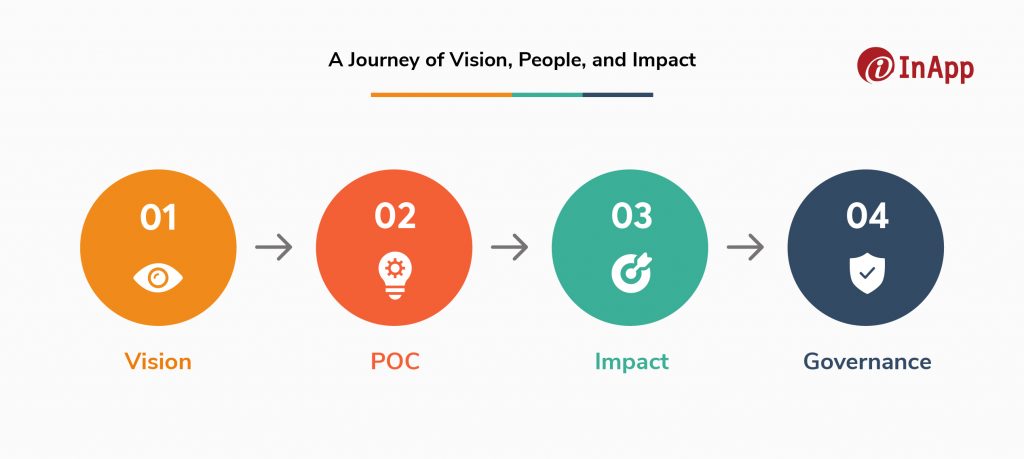
Now, as we scale, my focus has shifted to setting up robust processes, systems, and infrastructure that will enable the entire organization to become “AI native.” It is about embedding AI thinking and capabilities into the very fabric of our company, making it a natural part of how we operate. This is not about technology alone but more about fostering a culture of innovation and data-driven decision-making.
Throughout this journey, one aspect that has remained a constant focus is the responsible implementation of AI. We are actively working on incorporating AI Governance, Ethics, and Privacy guidelines. These aren’t just buzzwords; they are essential principles that will ensure our AI initiatives create a positive impact and build trust with our customers. We plan to roll out these guidelines across the organization soon, ensuring that as we embrace AI, we do so with integrity and a strong sense of responsibility.
The journey continues, but the foundation remains strong…
AI data governance is a framework for managing, controlling, and securing data used in AI systems across their lifecycle.
Poor governance can cause biased results, unreliable outcomes, compliance issues, and lower returns on investment, even if the models work well technically.
Back box refers to the lack of transparency in AI models, making it difficult to trace how decisions are made.
Data silos are separate data sources that cannot be easily combined, which makes it hard to manage data and prepare for AI.
Unstructured data, like text, video, or audio, is harder to organize and manage, so it is more challenging to keep it high-quality and relevant.
Shadow AI refers to the unauthorized use of AI tools by employees, which can bypass governance controls and create security and compliance risks. It increases the risk of data leakage, compliance violations, and a lack of traceability in AI outputs.
Passive data governance uses fixed rules and manual steps, which cannot keep up with the fast-changing and growing needs of AI data.
Organizations can ensure AI compliance and data security by using tools like data lineage tracking, privacy-enhancing technologies, and human-in-the-loop reviews for high-risk use cases.