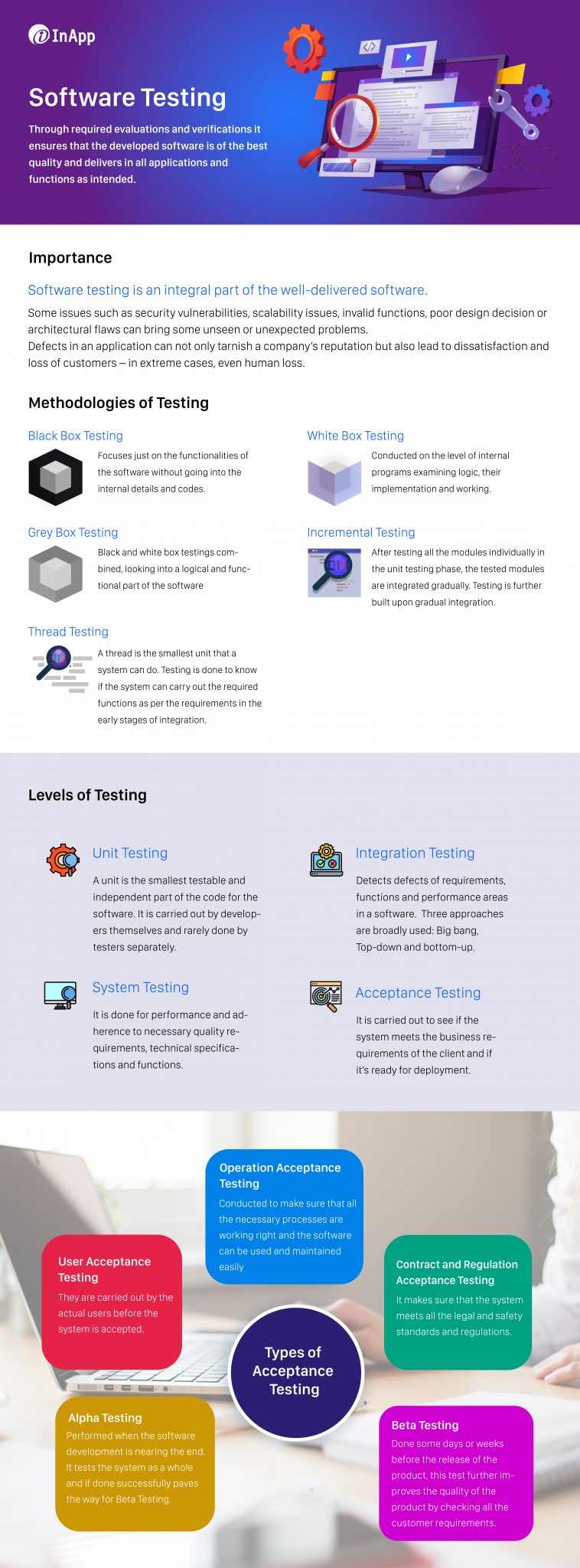
To prevent unexpected problems during the real-world use of any software, it is of utmost importance to test them carefully using appropriate software testing types. In the software industry, independent software testing and quality assurance are of critical significance. The software testing life cycle for an application depends on the application and type. An application can be subjected to scores of software testing before finally being used by end-users. InApp infographic gives an easily understandable overview of different software testing tools and software testing approaches.
Independent Software Testing – Through required evaluations and verifications, it ensures that the developed software is of the best quality and delivers all applications and functions as intended.
Software testing is an integral part of well-delivered software.
Issues such as security vulnerabilities, scalability issues, invalid functions, poor design decisions, or architectural flaws can bring some unseen or unexpected problems.
Defects in an application can tarnish a company’s reputation and lead to dissatisfaction and loss of customers – in extreme cases, even human loss.
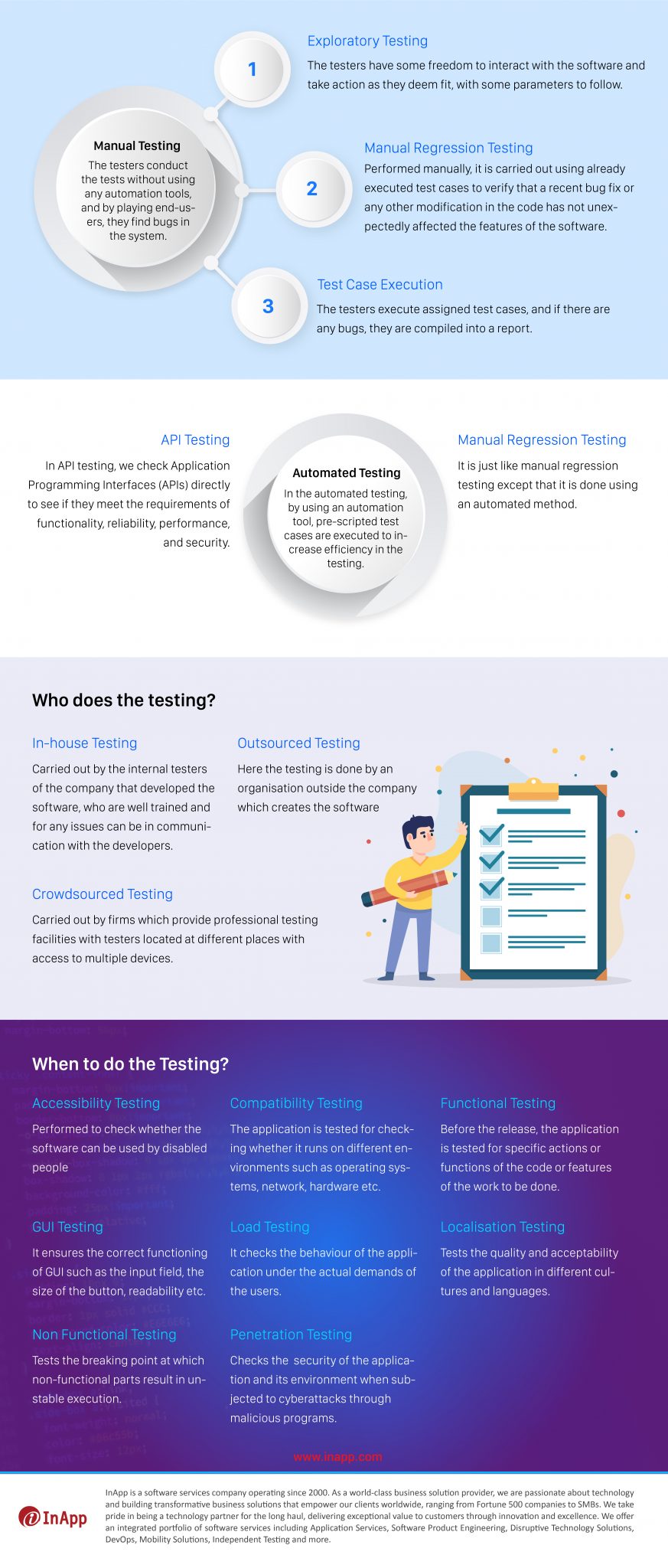
The testers conduct the tests without using any automation tools, and by playing end-users, they find bugs in the system.
In automated testing, pre-scripted test cases are executed by using an automation tool to increase efficiency in the testing.
API Testing: In API testing, we check Application Programming Interfaces (APIs) directly to see if they meet the requirements of functionality, reliability, performance, and security.
Automated Regression Testing: It is just like manual regression testing except that it is done using an automated method.
In-house Testing: Carried out by the internal testers of the company that developed the software, who are well trained and for any issues can be in communication with the developers.
Outsourced Testing: Here, the testing is done by an organization outside the company which creates the software
Crowdsourced Testing: Carried out by firms that provide professional testing facilities with testers located at different places with access to multiple devices.
Accessibility Testing: Performed to check whether disabled people can use the software
Compatibility Testing: The application is tested for checking whether it runs on different environments such as operating systems, networks, hardware, etc.
Functional Testing: Before the release, the application is tested for specific actions or functions of the work’s code or features.
GUI Testing: It ensures the correct functioning of GUI, such as the input field, the size of the button, readability, etc.
Load Testing: It checks the behavior of the application under the actual demands of the users.
Localization Testing: Tests the quality and acceptability of the application in different cultures and languages.
Non-Functional Testing: Tests the breaking point at which non-functional parts result in unstable execution.
Penetration Testing: Checks the application’s security and its environment when subjected to cyberattacks through malicious programs.