From my experience working on construction-focused software platforms, I have found that API-first development can make a strong difference as a platform grows. By separating business logic from the applications that consume it, APIs can make integrations easier, support modular architectures, and allow individual capabilities to evolve without repeatedly changing the entire system.
Modern construction software rarely works on its own anymore. A typical platform may connect project management, CRM, engineering, reporting, mobile apps, document management, and other external tools.
Each of these systems needs access to business information. For example, a project-management platform may need to expose information about projects, users, project status, collaboration, or other workflows to different applications and services.
When these capabilities are tightly coupled to one application, each new requirement can add complexity. With an API-first approach, business capabilities are exposed through well-defined interfaces, allowing different applications and services to use them without being tightly coupled to the underlying implementation.
For me, API-first is more than simply building REST APIs. The key is treating APIs as a core part of the product architecture from the start. Instead of building an application first and considering integrations later, teams define how systems and services will communicate as part of the initial design.
This creates a separation between:
I saw the value of this approach while working on a construction project-management platform, where I designed and implemented REST APIs around project-management workflows. Keeping the business logic centralized allowed different parts of the product to consume it consistently instead of duplicating the same logic across interfaces.
This also helped as the platform evolved. A change to the user interface did not necessarily require a redesign of the underlying business logic. Introducing another consumer for an existing capability could also be simpler when the API contract was already established.
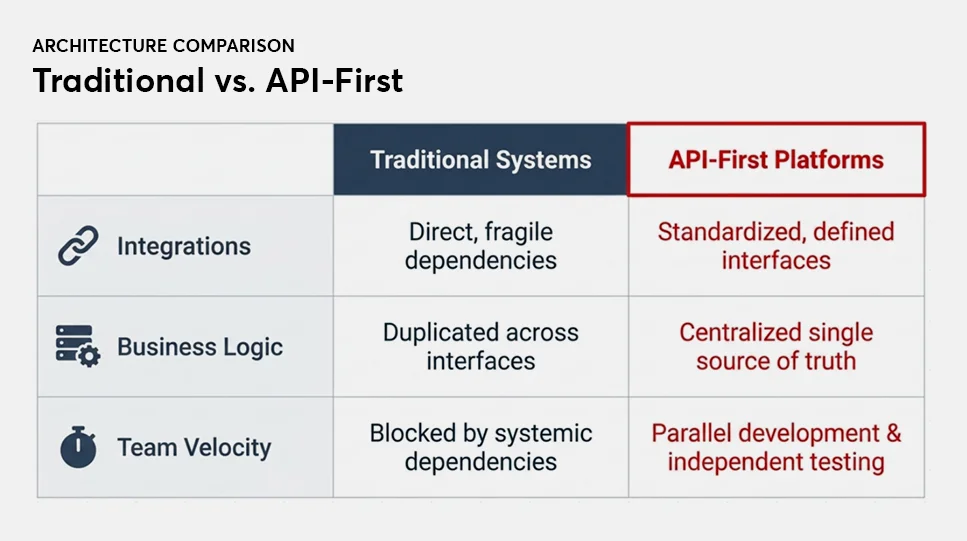
Construction businesses rarely use a single software system. As companies adopt new tools and services, integration requirements continue to grow. An API-first platform provides a practical way of handling this because systems communicate through defined interfaces rather than direct dependencies on internal implementation details.
This makes it easier to add new integrations without having to redesign the whole platform. Web apps, mobile apps, or other internal services can also use existing backend capabilities instead of rebuilding the same business logic from scratch.
I also worked on a project where microservices improved modularity and scalability. What I found important was that the benefit was not simply dividing an application into smaller pieces. The real value came from creating clear boundaries between business capabilities.
When those boundaries are exposed through well-designed APIs, individual components can evolve with less impact on the rest of the system. If one part of a platform experiences significantly higher usage than another, a modular architecture can make it easier to address that capability independently.
However, API-first doesn’t mean turning every function into a separate service. Poorly designed APIs can lead to too many network calls, tightly connected components, inconsistent data, difficult versioning, and added complexity. The goal is to identify the right business capabilities and expose them through simple, stable interfaces.
Scalability is about more than handling traffic. It is easy to associate scalability primarily with more servers, database capacity, or better cloud resources, but application architecture matters too. A platform can have powerful infrastructure and still be difficult to scale if the application is tightly coupled.
API-first design can support independent evolution and reusable business capabilities while fitting naturally into modern cloud architectures. While working on construction-related applications, I used AWS services like Lambda and S3 alongside backend APIs. This showed me the value of keeping application responsibilities separate and designing components that can evolve independently.
One practical lesson I learned is that API-first architecture alone does not guarantee a fast system. If database queries are inefficient, users will still experience slow responses. While developing backend services, I optimized Oracle database queries to improve response times and overall application performance.
This showed me that API design, database design, caching, infrastructure, monitoring, and application architecture all need to work together. A well-designed API still depends on the systems underneath it.
Construction platforms can involve very different user roles, including administrators, engineers, customers, sales teams, and other operational users. In a previous construction-domain project, I worked on backend functionality supporting project lifecycle management, including project creation, versioning, collaboration, and status transitions. I also worked on multi-role dashboards and server-side validation.
That experience reinforced another advantage of API-driven systems: backend capabilities can be designed around business operations rather than around a single screen or user interface. This makes it easier for different parts of the platform to consume the same underlying capabilities.
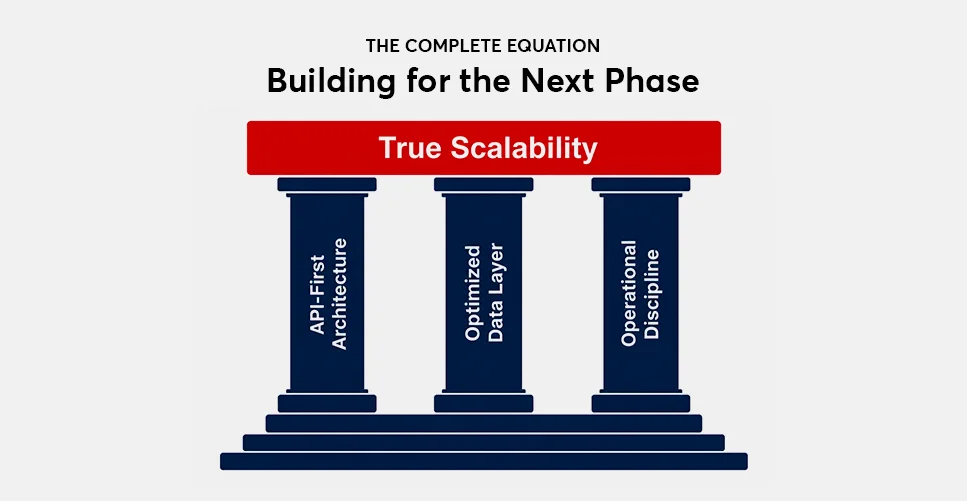
As systems become more interconnected, diagnosing problems becomes more challenging. A failure in one service can affect another API or user workflow, which makes centralized error handling, structured logging, validation, and monitoring important.
In my previous project, I implemented centralized error handling, structured logging, and server-side validation. I also worked on more than 80 client and production issues involving collaboration logic, dashboard inconsistencies, and performance bottlenecks.
These experiences reinforced an important lesson: an API-first architecture needs operational discipline behind it.
When APIs have clear contracts and business responsibilities are well separated, developers can work on different areas with fewer dependencies. This can help teams develop features in parallel, reuse existing services, reduce duplicated business logic, test components independently, and deploy changes with lower risk.
I experienced this during periods of significant change, when clear ownership of backend modules and well-defined APIs helped the team deliver features without repeatedly revisiting unrelated parts of the system.
Construction software will continue to become more connected. New applications, integrations, analytics capabilities, mobile experiences, and emerging technologies will place greater demands on the underlying platforms.
This is where architectural flexibility becomes important. A platform built around well-defined APIs can provide a foundation for introducing new consumers and capabilities without repeatedly rebuilding the core system.
For me, API-first development is not about creating as many APIs or services as possible. It is about creating clear boundaries around meaningful business capabilities so they can evolve as the business and its technology requirements change.

API-first development means treating APIs as a core part of the product architecture from the beginning, rather than building the application first and considering integrations later.
It can allow business capabilities to evolve independently, support multiple consumers, and reduce the impact of changes on the rest of the application.
Yes. APIs allow systems to communicate through defined interfaces rather than direct dependencies on internal implementation details, making it easier to introduce new integrations and applications.
No. API-first architecture and microservices can work together, but API-first is an architectural strategy focused on how business capabilities are exposed and consumed.
No. API design alone does not guarantee performance. Database design, query optimization, caching, infrastructure, monitoring, and application architecture also need to work together.
No. Creating separate services for every function can introduce unnecessary complexity. The focus should be on identifying meaningful business capabilities and exposing them through stable, well-designed interfaces.