According to a report by Cybersecurity Ventures, cybercrime will cost the world $10.5 trillion annually by 2025. With the increasing threat of cyber attacks, data breaches, and human error, it’s more important than ever to take steps to protect your company’s sensitive information.

In this blog post, we’ll discuss seven proven techniques that can help keep your business safe and secure. From employee training to security software, data encryption, and disaster recovery planning, these techniques will give you a solid foundation for preventing data loss and safeguarding your company’s valuable assets.
Data Loss Prevention (DLP) is a security strategy to detect, monitor, and prevent the unauthorized or accidental sharing of sensitive information.
DLP solutions are used to identify and protect sensitive data, such as credit card numbers, Social Security numbers, and confidential business information from being lost, stolen, or misused. The goal of DLP is to protect an organization’s sensitive information and keep it confidential. It can be achieved by monitoring, detecting, and preventing sensitive data from being transferred, stored, printed, and shared in an unauthorized manner.
DLP solutions can be implemented in a variety of ways — including through software, hardware, or a combination of both — and can be applied to various types of data and communications, such as email, file transfers, and instant messaging.
DLP typically works by identifying, monitoring, and protecting sensitive data using various technologies and methods such as:
1. Data discovery: DLP solutions scan and identify sensitive data based on predefined criteria, such as credit card numbers or Social Security numbers. This process helps organizations understand what sensitive information they have and where it is located.
2. Data monitoring: DLP solutions monitor network traffic, email, and other forms of communication for sensitive data. This capability helps organizations detect and prevent data breaches, data exfiltration, and other malicious activities.
3. Data protection: DLP solutions can take various actions to protect sensitive data, such as encrypting, blocking, or quarantining sensitive information.
4. Data governance: DLP solutions can be used to enforce policies and procedures related to the handling of sensitive data, such as data retention, data archiving, and data deletion.
5. Data loss prevention policies: DLP solutions can be configured to enforce data security policies and compliance regulations by preventing sensitive data from being sent to unauthorized recipients, blocking the use of unsecured communication channels, and alerting security personnel to potential data breaches.
6. Reporting and analysis: DLP solutions can provide detailed reporting and analysis of data loss incidents, which can be used to improve security policies and procedures.
In short, DLP solutions work by identifying, monitoring, and protecting sensitive data, and allowing organizations to take appropriate actions to prevent data breaches and protect sensitive information.
Several types of DLP solutions are available, each of which addresses different aspects of data security:
1. Network DLP: These solutions monitor network traffic and identify sensitive data as it moves across the network. They can also block or quarantine sensitive data to prevent it from being transferred to unauthorized locations.
2. Endpoint DLP: These solutions run on individual devices, such as laptops and smartphones, and monitor for sensitive data on those devices. They can also prevent sensitive data from being copied to removable storage devices or shared via email or instant messaging.
3. Cloud DLP: These solutions monitor and protect sensitive data in cloud-based storage and collaboration platforms, such as Google Drive and Dropbox.
4. Email DLP: These solutions monitor and protect sensitive data in email messages, attachments, and other forms of electronic communication. They can also prevent sensitive data from being sent to unauthorized recipients.
5. Application DLP: These solutions monitor and protect sensitive data within specific applications, such as CRM, ERP, and accounting software.
6. Data Discovery DLP: These solutions scan data storage to identify and classify sensitive data based on predefined criteria, such as credit card numbers or Social Security numbers, and allow organizations to monitor and protect it.
7. Mobile Device DLP: These solutions monitor and protect sensitive data on mobile devices, such as smartphones and tablets, and can prevent sensitive data from being copied to removable storage devices or shared via email or instant messaging.
Overall, the type of DLP solution that an organization chooses will depend on the specific data security needs and requirements of the organization.
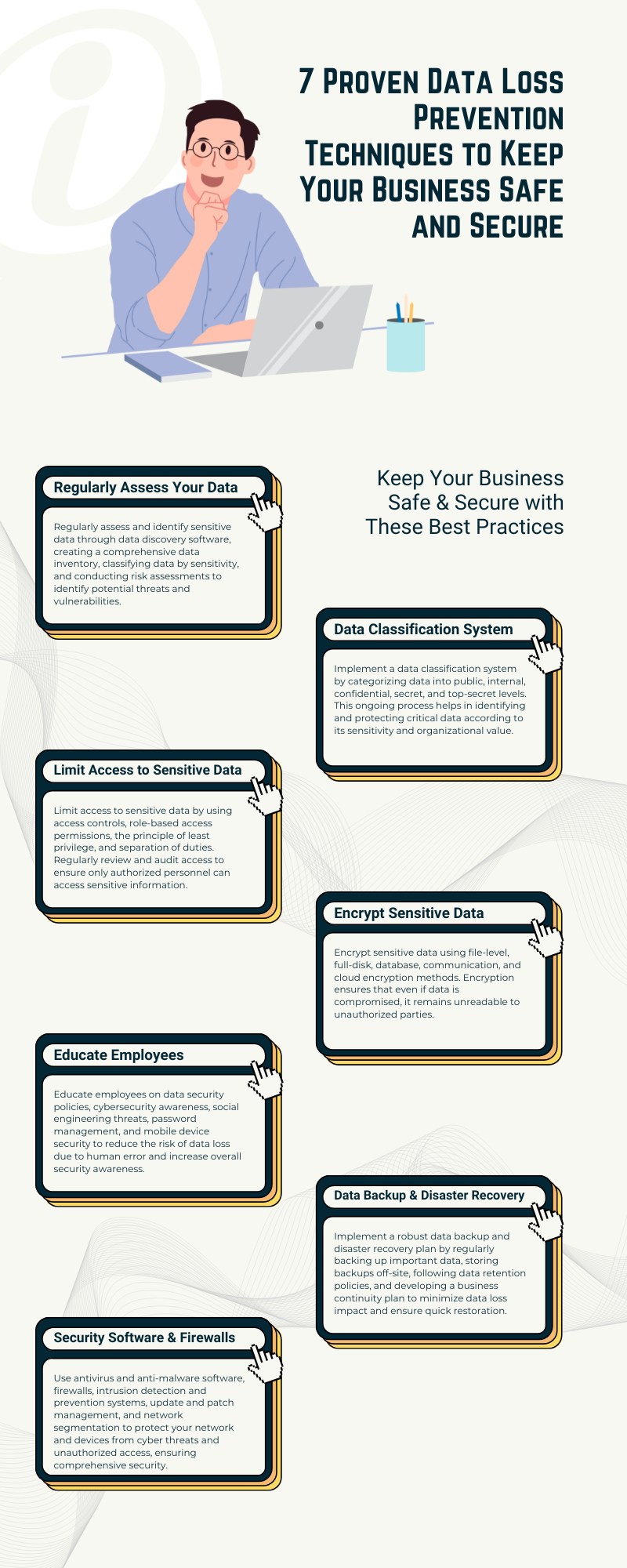
Regularly assessing and identifying sensitive data is an essential step in data loss prevention. This process involves identifying and locating all sensitive data within your organization, including personal information, financial data, and confidential business information. There are a few ways to achieve this.
I. Data Discovery: Use specialized software to scan your organization’s data storage systems, including servers, workstations, and mobile devices, to identify sensitive data based on predefined criteria, such as credit card numbers or Social Security numbers.
II. Data Inventory: Create a comprehensive inventory of all sensitive data within your organization, including where it is stored, who has access to it, and how it is being used.
III. Data Classification: Classify data based on its sensitivity and value to the organization to identify and protect the most critical data.
IV. Risk Assessment: Conduct a risk assessment to identify potential threats to your sensitive data and the likelihood of a data loss event occurring.
Once you have identified and located your sensitive data, you can take steps to protect it, such as implementing data encryption, access controls, and security software. Regularly assessing and identifying your sensitive data also allows you to keep your data security practices up to date and identify any new threats as they arise.
Implementing a data classification system is an essential part of data loss prevention. This process involves assigning labels or tags to different types of data based on their sensitivity and value to the organization. By classifying data, you can identify and protect the most critical data, and also create policies and procedures that are specific to different data types.
Here are some commonly used data classification levels.
It’s important to note that data classification is not a one-time process, but an ongoing task. As new data is created and stored, it is important to keep the data classification updated.
Limiting access to sensitive data is a key aspect of data loss prevention. This process involves restricting access to sensitive data to only those who need it to perform their job duties. Here are some best practices to limit access to sensitive data.
By limiting access to sensitive data, you can prevent unauthorized access, data breaches, and data exfiltration. It also helps organizations to comply with regulations such as GDPR and HIPAA that require organizations to limit access to personal data and provide transparency about who has access to that data.
Encrypting sensitive data is another way to achieve data loss prevention. Encryption is the process of converting plaintext data into an unreadable format, called ciphertext, to protect it from unauthorized access or data breaches. You can choose from different encryption methods.
Encryption provides an additional layer of security for sensitive data. Even if data is stolen or compromised, it will be unreadable to unauthorized parties, making it much harder for them to extract or make use of the data.
Educating employees about data security is another essential aspect of data loss prevention. This process involves training employees on data security best practices and making them aware of the risks and consequences of data loss.
You should train employees on the core aspects of data security.
By educating employees on data security best practices, you can help to reduce the risk of data loss due to human error. Employees who are aware of the risks and consequences of data loss are more likely to take the necessary precautions to protect sensitive data.
Implementing a data backup and disaster recovery plan is key to preventing data loss. This process involves regularly backing up important data, and having a plan in place to restore data in case of data loss or system failure.
Consider these key elements of a backup and disaster recovery plan.
Having a data backup and disaster recovery plan in place can help organizations minimize the impact of data loss and ensure that critical data can be quickly restored.
Security software, such as antivirus and anti-malware programs, can protect your network and devices from known and unknown cyber threats. Firewalls, on the other hand, can act as a barrier between your network and the internet, controlling access to your network and blocking malicious traffic.
There are several types of security software and firewalls.
By implementing security software and firewalls, you can protect your network and devices from cyber attacks and other malicious activities. It also helps organizations to comply with regulations that require organizations to implement security software and firewalls to protect sensitive data.
In conclusion, data loss prevention is a crucial aspect of keeping any business safe and secure. By implementing the seven proven techniques outlined in this article, including regular backups, encryption, access controls, and employee training, you can greatly reduce the risk of data loss and protect your company’s sensitive information. Additionally, it is important to stay updated on the latest security trends and technologies to ensure that your data is protected against new and evolving threats.