Healthcare data analytics helps hospitals turn large volumes of clinical and operational data into actionable insights. By integrating fragmented systems and applying AI-driven analytics, healthcare organizations can improve patient outcomes, optimize operations, and enable faster data-driven decisions across clinical and administrative teams.
Healthcare organizations produce large volumes of data, but much remains underutilized due to disconnected systems and slow reporting. Analytics platforms address this by integrating data sources and providing real-time insights to support improved clinical and operational decisions.
Healthcare organizations generate over 50 petabytes of data annually, yet much of it is not fully leveraged in clinical and operational decision-making.
Several structural challenges prevent healthcare systems from fully utilizing their data. These include:
Many healthcare institutions continue to depend on fragmented infrastructure and outdated electronic health record systems.
Common challenges include:
For example, a hospital’s billing platform may not integrate with patient monitoring systems, limiting its ability to analyze care delivery and operational performance across departments.
Many healthcare organizations continue to use spreadsheet-based reporting and manual data compilation.
This approach creates several problems:
Studies show manual processes can consume up to 30% of clinicians’ time, reducing time available for direct patient care.
Real-time analytics platforms address these challenges by automating data processing and providing continuously updated dashboards.
Healthcare organizations must comply with strict privacy and security regulations.
Key compliance challenges include:
While these regulations are essential, they can hinder digital transformation if organizations lack modern data management.
Implementing analytics platforms turns data from an operational burden into a strategic asset. Advanced analytics enables healthcare leaders to shift from reactive decision-making to proactive care delivery.
Predictive analytics uses machine learning models to analyze clinical data and identify early warning signals.
These models help healthcare providers:
In many healthcare settings, predictive analytics systems can identify warning signs up to 48 hours before clinical deterioration, allowing earlier intervention and better patient outcomes.
Healthcare analytics platforms offer dashboards that track key operational metrics.
These dashboards help hospitals monitor:
With real-time insights, healthcare administrators can improve patient flow, reduce bottlenecks, and optimize resource allocation.
Population health analytics identifies patterns within large patient groups.
Healthcare organizations can use these insights to:
By combining clinical data with Social Determinants of Health (SDOH), organizations gain deeper insight into factors that affect patient outcomes.
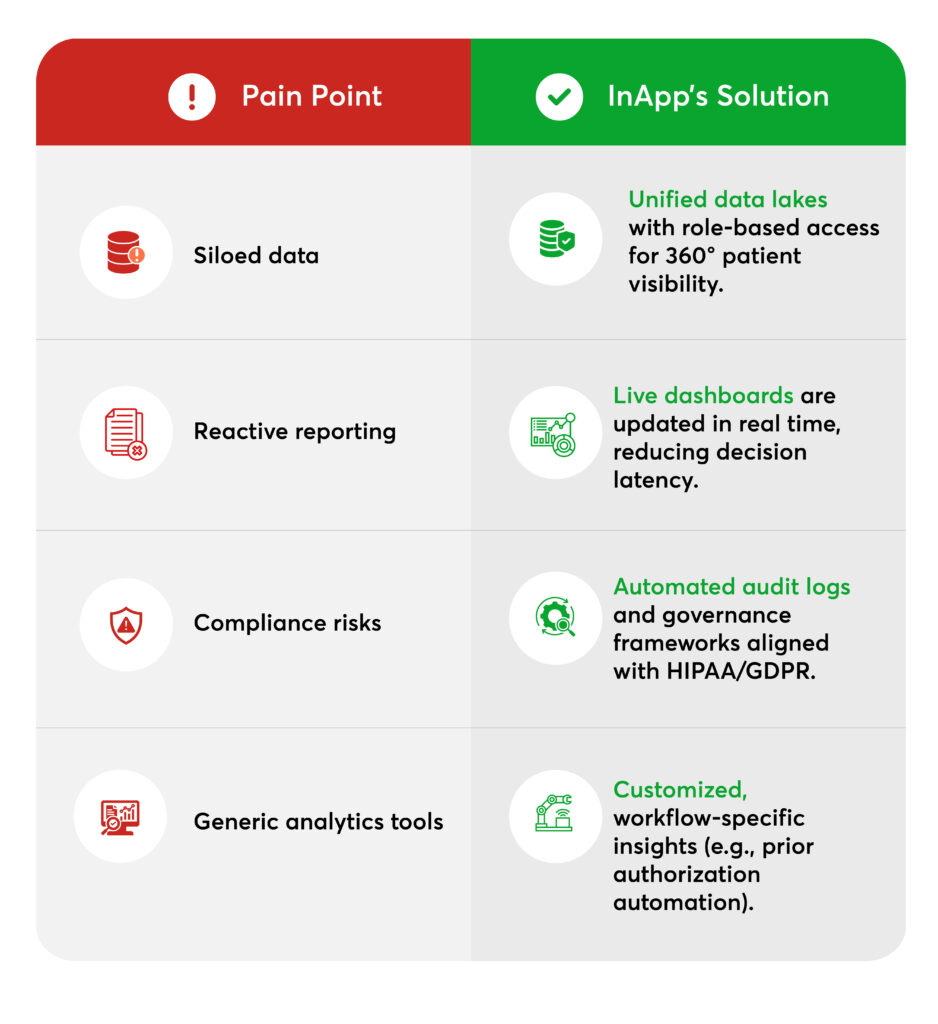
InApp doesn’t rip and replace; it connects. Using APIs and middleware, we integrate data from legacy EHRs like Epic and Cerner, billing systems, IoT devices, and wearables into a unified cloud data lake. For a pharmaceutical client, this approach consolidated data from Salesforce, SharePoint, and Google Analytics into a single HIPAA-compliant platform.
Solving CXO Pain Points with Precision
Learn more about InApp’s Healthcare Software Development here
Mayo Clinic uses advanced predictive analytics to detect early signs of sepsis in hospitalized patients. By integrating real-time EHR data and applying machine learning, the system alerts clinicians to at-risk patients before symptoms worsen. This proactive approach enables timely interventions and improves patient outcomes.
Cleveland Clinic uses AI-powered analytics to optimize surgical scheduling and resource allocation. By analyzing historical procedure times, patient flow, and real-time staffing data, they have reduced operating room downtime and improved patient throughput. This data-driven approach enhances both patient experience and operational efficiency.
Kaiser Permanente has implemented a unified cloud-based analytics platform that aggregates data from EHRs, claims, and patient-generated sources across its network. This platform enables clinicians and care managers to identify high-risk populations, coordinate preventive care, and personalize interventions. As a result, chronic disease management and population health strategies have improved.
The next wave of healthcare analytics is not just about faster dashboards or more data points-it’s about fundamentally reshaping how care is delivered, regulated, and experienced. Here is a glimpse into the innovations that will define the next decade:
The future isn’t about replacing medical expertise with algorithms, but about amplifying it. Augmented intelligence will see AI-driven suggestions woven directly into clinician workflows: imagine a physician reviewing a patient’s chart and receiving real-time, context-aware recommendations for diagnostics, drug interactions, or care pathways-without ever leaving the EHR interface. Early pilots at institutions like Mount Sinai and Mayo Clinic are already demonstrating how this synergy can reduce cognitive overload and drive more consistent, evidence-based care.
Healthcare is shifting from a provider-centric model to a patient-partner approach. Secure digital portals and mobile apps now provide patients with access to their health records, personalized risk scores, and AI-generated wellness plans. Organizations such as Kaiser Permanente are pioneering shared care planning platforms, enabling patients and clinicians to co-design treatment strategies, track progress, and adjust goals collaboratively. This trend is increasing engagement, improving adherence, and improving outcomes.
Regulatory compliance is evolving from a reactive checklist to a predictive discipline. Advanced analytics allow healthcare organizations to continuously monitor workflows and flag anomalies, such as unusual access patterns or incomplete documentation, before they escalate into audit findings or breaches. Cleveland Clinic and other leaders are piloting machine learning models to identify emerging compliance risks, enabling early intervention and maintaining trust with regulators and patients.
As value-based reimbursement becomes standard, analytics is expanding beyond clinical metrics to include cost, quality, and patient-reported outcomes. The next generation of analytics platforms will support real-time tracking of episode costs, complication rates, and patient satisfaction, enabling executives to negotiate payer contracts, optimize care pathways, and demonstrate return on investment. Organizations such as Geisinger Health are already using these analytics to align incentives and deliver measurable value to patients and payers.
For healthcare CXOs, data analytics isn’t a luxury; it’s the cornerstone of sustainable innovation. InApp’s tailored solutions bridge the gap between legacy systems and cutting-edge intelligence, empowering organizations to deliver patient-centric care while optimizing costs and compliance.Ready to transform your data into a strategic asset? Explore InApp’s Healthcare Analytics Solutions or Contact Our Team for a customized roadmap.