The Internet of Things (IoT) is a network of physical devices, vehicles, home appliances, and other items embedded with sensors, software, and connectivity that enables them to connect and exchange data with other devices and systems over the Internet. The IoT has been growing in importance in various industries including healthcare, manufacturing, transportation, and agriculture, among others. According to a report by Statista, the number of connected devices worldwide is expected to reach 30.9 billion by 2025, up from 11.2 billion in 2019.
Data analytics is the process of examining large and varied data sets to uncover hidden patterns, correlations, and other insights that can inform business decisions. It is a crucial element in the IoT ecosystem as it helps organizations to make sense of the vast amounts of data generated by IoT devices. By analyzing this data, businesses can gain valuable insights that can help them improve operational efficiency, reduce costs, and enhance customer experience.
With the increasing adoption of IoT devices across various industries, the amount of data generated is growing exponentially. However, the real value of IoT lies in the insights that can be derived from this data. Data analytics can help organizations to unlock this value and make data-driven decisions that can have a significant impact on their business. In this post, we will look at what IoT data analytics can do, some of the ways it’s being used in the IoT, and the benefits it can bring.
Internet of Things analytics is the process of collecting, analyzing, and interpreting data generated by IoT devices. These devices can include sensors, smart appliances, wearables, and other connected devices that collect and transmit data over the Internet.
Internet of Things data analytics uses specialized software and tools to process the vast amounts of data generated by these devices to extract insights and make informed decisions. This undertaking may involve using techniques such as machine learning, data mining, and predictive analytics to identify patterns, correlations, and trends in the data.
The insights gained from Internet of Things data analytics can be used to improve operational efficiency, optimize business processes, enhance customer experiences, and identify new revenue streams. For example, a manufacturer may use IoT data analytics to monitor equipment performance in real-time, identify inefficiencies, and optimize production processes to improve productivity and reduce downtime. Similarly, a retailer may use IoT data analytics to track customer behavior and preferences, personalize marketing messages, and improve the customer experience.
Data analytics is crucial for the effective functioning of the IoT because it enables organizations to extract meaningful insights from the vast amounts of data generated by IoT devices. With the increasing number of connected devices, there is a growing need to process, analyze, and interpret the data generated by these devices to make informed decisions.
The IoT has the potential to transform various industries by enabling real-time monitoring, optimization, and automation. However, to unlock the full potential of IoT, organizations need to process and analyze the vast amounts of data generated by IoT devices. Here are some reasons why data analytics is crucial for IoT:
The IoT has enabled businesses to collect vast amounts of data from connected devices, sensors, and machines. However, without proper analysis, this data remains useless.
By leveraging IoT data analytics, businesses can gain valuable insights into customer behavior, operational efficiency, and product performance, helping them make informed decisions and improve their products and services. For example, a manufacturing company can use IoT data to optimize its supply chain, reduce downtime, and increase productivity. By harnessing the power of IoT data analytics, businesses can streamline their operations, reduce costs, and improve customer satisfaction.
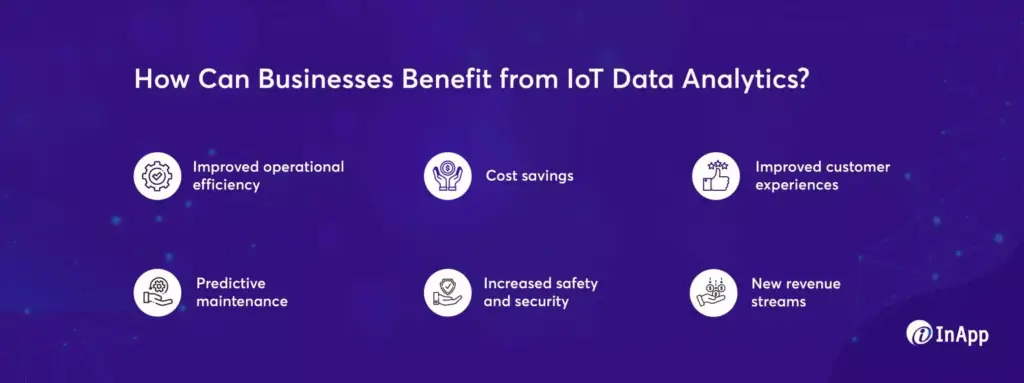
In conclusion, IoT data analytics offers a multitude of benefits for businesses. By collecting, analyzing, and interpreting data from IoT devices, businesses can gain valuable insights into their operations, customers, and markets. These insights can be used to improve efficiency, optimize processes, enhance customer experiences, and identify new revenue streams.
However, implementing Internet of Things data analytics can be complex and challenging. Businesses must address issues such as data management, security, interoperability, and skillsets to successfully implement IoT analytics. Moreover, implementing IoT analytics can be costly, requiring investments in new technologies, infrastructure, and personnel.
Despite these challenges, the potential benefits of IoT analytics make it a valuable investment for businesses looking to stay ahead of the competition. By carefully planning and executing an IoT analytics strategy, businesses can unlock the full potential of IoT data and drive growth, efficiency, and profitability.