For years, many companies thought picking the biggest tech provider was the safest bet. These large firms offered global reach, proven processes, a wide range of skills, and the reassurance of a familiar name.
Today, software delivery has changed. Many projects now depend less on large teams because of AI tools, automation, and updated engineering techniques, and more on strong engineering abilities, fast decision-making, and clear accountability.
This leads enterprise technology leaders to ask: Does picking the biggest provider really make a project safer, or is it just the easiest choice to justify?
Large providers remain the right choice for many enterprise initiatives. These generally include:
In these cases, having a large organization truly helps.
But many projects like modernization, software development, AI, cloud moves, and process changes don’t need huge delivery teams. Extra layers in these cases just add needless complexity.
Approval cycles lengthen, communication goes through multiple management layers, and team continuity is harder to maintain as resources shift across projects, which slows processes.
A smaller, focused team of skilled engineers often works faster because they spend less time on internal coordination and more time solving technical problems.
The real issue isn’t whether big providers can deliver; they often can. The better question is whether enterprises choose partners for the right fit, not just for their name or size.
Many enterprises experience the same challenge when working with large technology providers. During the sales process, senior architects and experienced consultants lead discussions, demonstrate technical expertise, and shape the proposed solution.
Once the contract is signed, responsibility may shift to a different delivery team.
This can create:
To avoid delivery risks, enterprise buyers should ask early: Who will work on the project? Will the architects stay involved throughout delivery? How stable will the delivery team be?
Many assume that adding more people speeds up software delivery. In reality, bigger teams often need more coordination, like extra project managers, more meetings, more approvals, and longer communication chains.
These steps are needed for big projects, but they also take up time that could be used to solve technical issues.
In contrast, skilled engineering teams often move faster because they communicate directly, make quick decisions, and understand the system well. They spend less time on meetings and more time getting things done. The real advantage isn’t just having fewer people, but having the right experts.
Large engagements frequently involve multiple stakeholders. As responsibility spreads across layers, identifying clear ownership becomes harder. Issues may move between teams before resolution, increasing delays and reducing accountability.
A right-sized engineering partner provides:
When clients communicate directly with resources making technical decisions, problems are resolved faster because ownership is clear from the start.
Traditional technology engagements often measure success using commercial metrics such as:
These business metrics are important, but they don’t always show if the software is truly valuable. Modern software partnerships should also look at:
When service providers and clients agree on these goals, both sides benefit from a shared idea of success, not just from tracking effort.

Recent problems in consulting offer useful lessons for technology buyers. The point isn’t to compare software engineering to management consulting, but to highlight how important governance, quality, and accountability are in all professional services.
Recent developments involving the Big Four have prompted concerns regarding quality control, conflicts of interest, senior oversight, and accountability.
For example, one of the Big Four’s agreed to partially refund the Australian government after a report contained fabricated quotations and references to nonexistent research. This incident showed that advanced technology, without expert review, can undermine quality and trust.
Similarly, the UK’s operational separation of audit and non-audit practices within the Big Four reflects broader concerns about independence, governance, and accountability.
These instances don’t mean that big consulting or tech firms do poor work. The real lesson is that a strong brand can’t replace clear processes, experienced oversight, and clear ownership.
The same applies to software delivery. Enterprises should judge engineering partners by how they handle quality, accountability, and delivery, not just by their size or reputation.
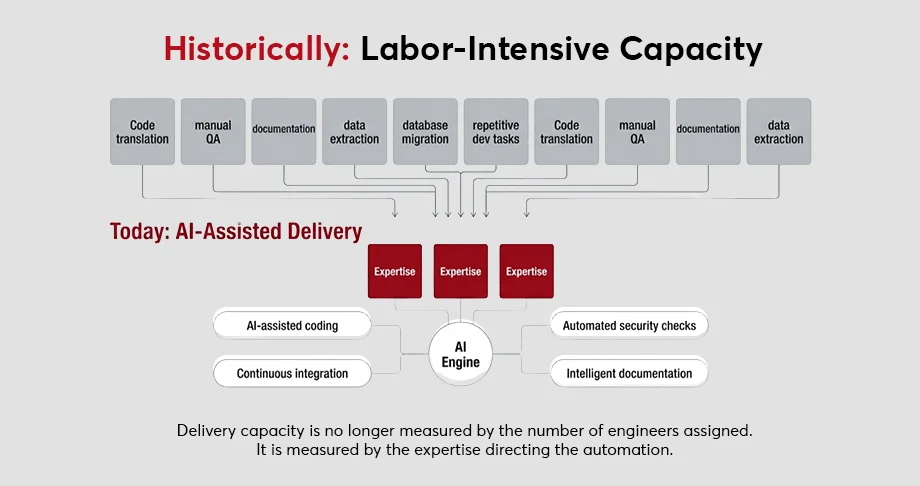
For many years, large technology providers benefited from one major advantage. Software projects required substantial manual effort, making delivery capacity closely tied to headcount.
Historically, labor-intensive activities included:
Now, AI tools and automation are changing how work gets done.
Experienced engineering teams now use:
As a result, delivery capacity is no longer measured mainly by the number of engineers assigned.
It is important to note that AI is not a replacement for engineering expertise. Governance, security, testing, product judgment, and human validation still remain essential throughout delivery.
Technology without expert oversight can produce errors faster rather than improve outcomes. This changes how enterprises evaluate software partners. Instead of focusing mainly on headcount, organizations must consider:
These capabilities increasingly determine delivery success in modern software engineering.
Choosing the right engineering partner is not about finding the smallest or largest provider. It is about finding a team with expertise, a delivery model, and accountability that align with the project’s needs.
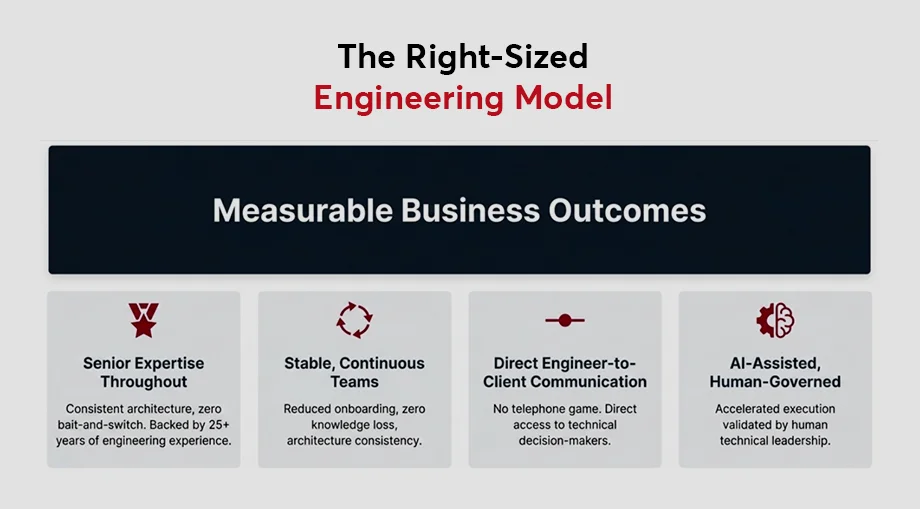
Clients must have access to experienced engineers from discovery through deployment. Senior expertise should be engaged throughout the project, not just after the sales process.
At InApp, this approach reflects more than 25 years of software engineering experience and early adoption of AI and machine learning technologies. The focus has always been on applying technology where it creates measurable business value, not just following business trends.
When senior experts remain involved, clients benefit from:
Stable teams develop a deeper understanding of the client’s business, technology environment, and long-term goals.
This reduces:
Maintaining continuity lets engineering teams spend more time building solutions and less time rebuilding project knowledge.
Clients should be able to communicate directly with the people making important technical decisions.
Direct communication improves:
When technical discussions happen directly between engineers and client stakeholders, decisions are faster, and misunderstandings are reduced.
AI and automation should improve productivity, testing, documentation, and code quality, but experienced engineers must remain responsible for critical decisions.
Human oversight is essential for:
AI delivers the greatest value when it accelerates experienced engineering teams instead of replacing their expertise.
Technology decisions must support the client’s long-term business goals.
Where appropriate, engineering partners should prioritize:
This does not mean open source is always the right choice. Technology decisions should be driven by business requirements, not provider preferences.
Successful partnerships focus on business outcomes rather than delivery effort.
Meaningful measures include:
These outcomes better measure project success than team size or hours billed.
Selecting a software engineering partner requires evaluating how the provider delivers, not how large the organization is.
An enterprise needed to identify accessibility violations and fix them. When choosing a vendor, they focused more on how the engineering team would handle the project than on the vendor’s size.
They asked:
InApp assigned a dedicated engineering lead who remained involved from discovery through deployment. They provided clear documentation and accessibility issues were translated into
structured prompts that enabled AI to generate context-aware fixes within legacy
JSP constraints. As business needs changed, the delivery team adjusted the plan without interrupting daily work.
The result? The team was able to attain over 90% conformance with WCAG 2.1 AA standards and delivered a VPAT-aligned compliance posture.
AI has changed how enterprise software is built, shifting the focus from team size to engineering expertise, accountability, and AI-assisted productivity. While large providers remain the right choice for some initiatives, they are not automatically the best fit for every project.
For many modernization, AI, cloud, and software engineering projects, delivery fit is a better predictor of success than organizational size.
Planning a software product, modernization, AI, cloud, or process transformation initiative? Talk to InApp about the team structure and delivery approach that best fits your project’s goals.