Child welfare agencies face ongoing challenges in managing complex information, leading to inefficiencies in case tracking and service coordination for children and families.
To address these issues, the federal government introduced the Comprehensive Child Welfare Information System (CCWIS), which promotes a flexible and effective approach to data management focused on improving outcomes for children.
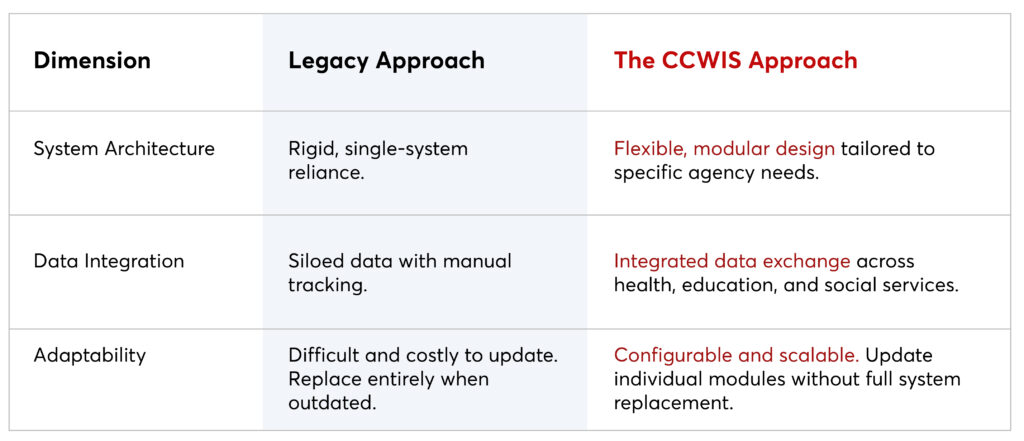
CCWIS features a flexible, modular design that allows agencies to tailor solutions to their needs rather than relying on a single system. It also supports integration with external systems for data exchange across health, education, and social services.
Data quality is a core component of CCWIS. Agencies are required to implement data quality plans, conduct regular reviews, and use automated processes to identify and correct errors. Systems must support reporting and oversight to ensure data is accurate, complete, and available for administration and compliance.
Implementing CCWIS involves more than acquiring new software. The CCWIS Final Rule emphasizes a modular, flexible approach, allowing agencies to use multiple systems instead of a single platform. Agencies must assess existing systems and plan enhancements through the Advance Planning Document (APD) process to meet federal requirements.
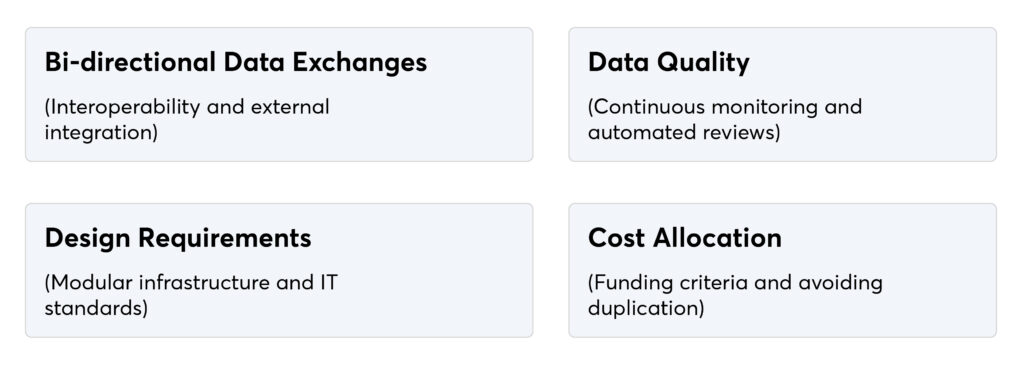
CCWIS sets requirements for data exchange, system integration, and reporting. Systems must support bi-directional data exchanges, maintain required data, and enable federal reporting and oversight.
Systems must also meet federal security and confidentiality standards for sensitive information. Compliance with these requirements is necessary for federal approval and funding.
The rule permits agencies to collect and exchange data across multiple systems, rather than relying on a single platform.
The rule establishes requirements to ensure data reliability, particularly when data is sourced from multiple systems. Data quality provisions of the rule require:
Federal funding is contingent on meeting specific criteria for system design and use. The functions/modules must:
CCWIS emphasizes a flexible, modular system design instead of prescribing specific functionality. Systems must be built to be reused, shared, and adapted over time. New CCWIS functions must:
Some of the benefits of CCWIS include:
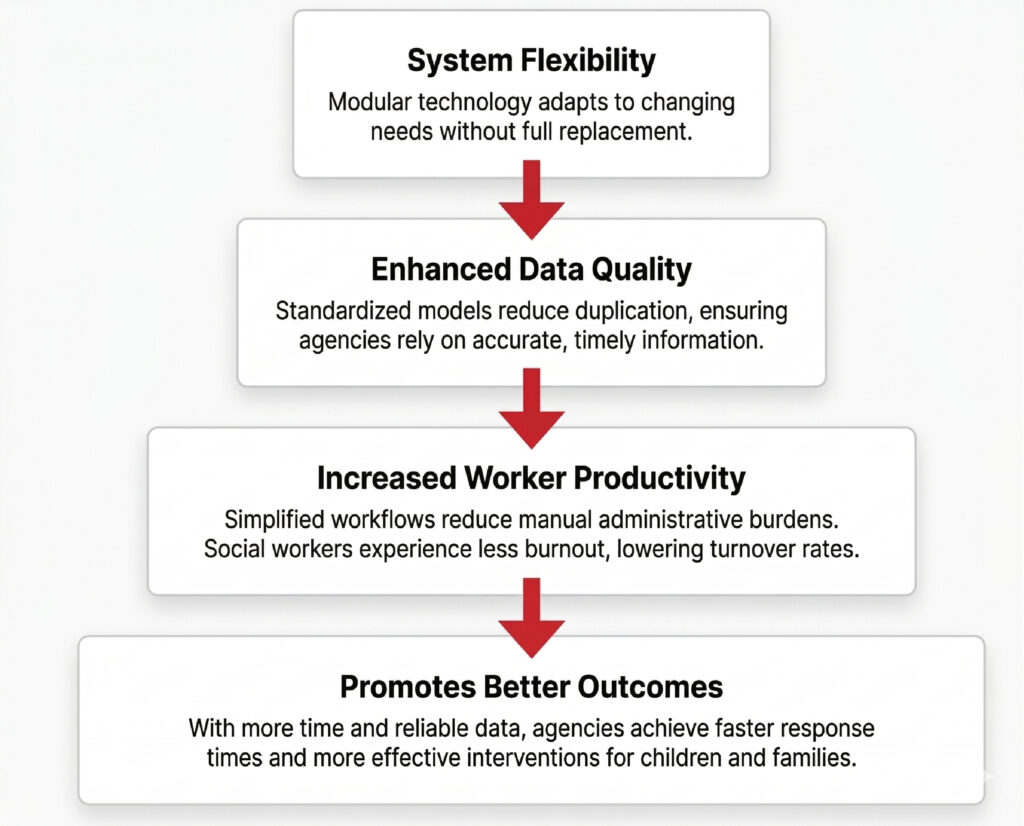
CCWIS strengthens data quality by enforcing standardized data models and validation processes. It reduces duplication and ensures consistency across systems, allowing agencies to rely on updated information for decision-making.
By simplifying workflows and reducing manual effort, CCWIS enables social workers to spend more time with children and families rather than on administrative tasks. Lower administrative burden helps reduce stress and burnout, supporting employee retention.
With improved access to timely, complete data, agencies can make more informed decisions. This enhances service coordination, response times, and intervention effectiveness for children and families.
Unlike older systems, CCWIS uses modular, configurable, scalable technology. Agencies can update and adapt the system to changing needs without replacing it entirely.
CCWIS often aligns with federal funding opportunities that support the development and modernization of child welfare systems.
CCWIS represents a shift from rigid, single-system child welfare models to flexible, data-driven ecosystems. Focusing on modularity, data quality, and interoperability helps agencies modernize their systems and maintain federal compliance.
Successful implementation requires careful planning, regulatory alignment, and strong data management. Agencies following this approach can achieve compliance and enhance program administration.