Back in 1974, the Transmission Control Protocol (TCP) defined how to establish and maintain a network conversation by which applications can exchange data. TCP controls the transfer of data via connection management, reliability, flow control, and congestion control features. TCP and the Internet Protocol (IP) have stood the test of time and defined the internet as we know it today.
Almost 40 years later, Google created the Quick UDP Internet Connections (QUIC) protocol to improve latency issues with TCP. Google designed QUIC to compensate for HTTP/2 deficiencies, provide robust and strong encryption, and reduce server/client handshake and packet loss. Today, the company uses QUIC as the default protocol for all its products. For example, when a user accesses Google’s services such as Gmail with the company’s Chrome web browser, the data transfer will use QUIC.
But QUIC hasn’t replaced the much older TCP yet. Let’s learn more about these two transport protocols.
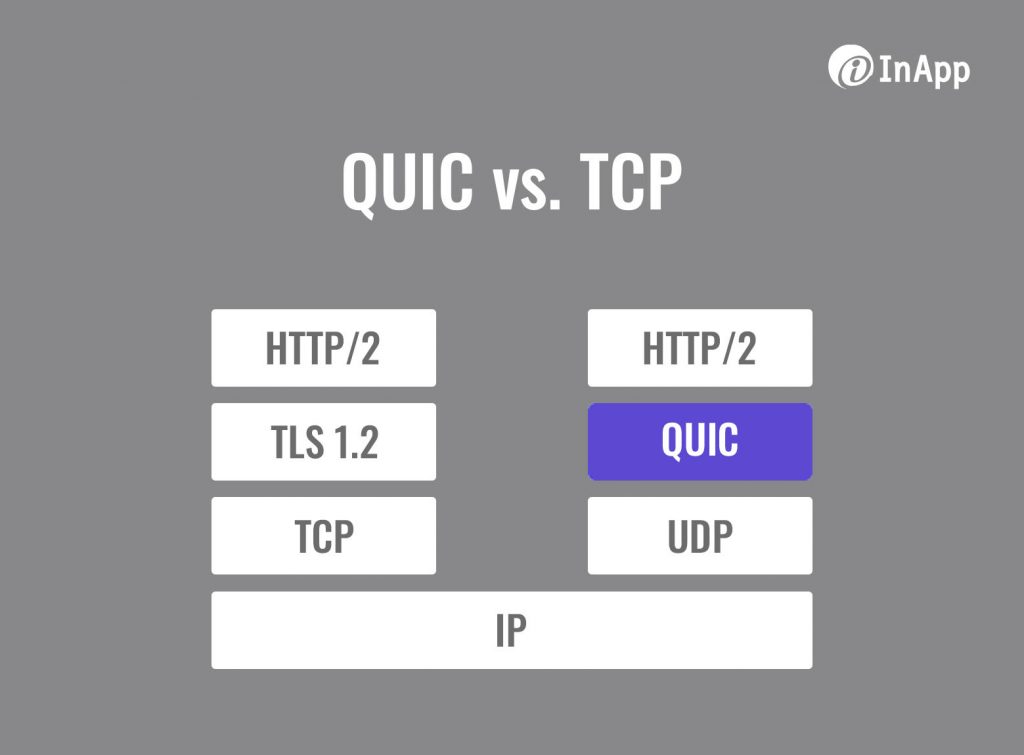
Both QUIC and TSP protocols manage communication between devices, wherever they are located. QUIC sits on the UDP, aka the User Datagram Protocol, a transport layer protocol. UDP forms the base of QUIC. Since UDP is a connectionless protocol, QUIC handles all of the logic to guarantee a reliable connection between a client and a server. In addition, QUIC is built into the application layer, meaning that any updates will not require OS changes.
Google’s goal for its QUIC protocol was to solve transport-layer and application-layer problems in modern web applications, while also requiring little or no change from application developers. From Google’s test results, QUIC does indeed perform better than TCP in transfer and average bandwidth used. The two are much closer in other tests, but QUIC still outperformed TCP in almost every measure, with the exception of jitter.
TCP and QUIC have two major differences:
QUIC provides…
The software development world moves quickly, and InApp prides itself on staying ahead of technology improvements and trends. That comes from our experience in providing full-cycle software development services to clients all over the world, including SaaS and software vendors, as well as companies looking to harness business innovation with digital transformation and emerging technologies.
Learn more about how InApp helps our clients achieve success.