In enterprise cloud operations, balancing speed and stability can be challenging. For one large organization using a standardized Azure foundation, customer onboarding had become a major bottleneck.
This article examines how the organization improved efficiency and stability by transitioning from manual processes and custom scripts to a unified Infrastructure-as-Code (IaC) approach.
The organization struggled with a hybrid provisioning approach that was neither fully manual nor fully automated, resulting in three main issues:
Networking, monitoring, and IAM were often configured manually, increasing the risk of human error.
Legacy PowerShell scripts were difficult to maintain, lacked version control, and were prone to configuration drift.
Without standardized sizing, overprovisioning became common, leading to higher monthly cloud costs.
The team used a modern technology stack to rebuild the foundation:
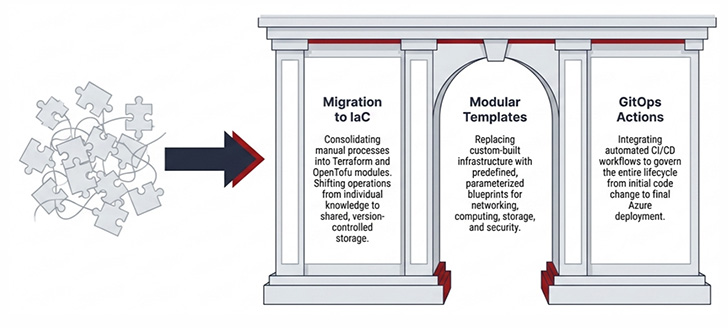
The first step was an audit and transformation phase. All legacy PowerShell scripts and manual processes were consolidated into clear Terraform and OpenTofu modules. This moved critical information from individual knowledge to shared, version-controlled storage.
Instead of building predefined infrastructure modules from scratch for each customer, the team developed a library of parameterized templates for networking, computing, storage, and security. Onboarding a new customer now requires only entering details such as location or size into a proven plan.
A major transformation began with the integration of GitHub Actions, automating the process from the initial code change:
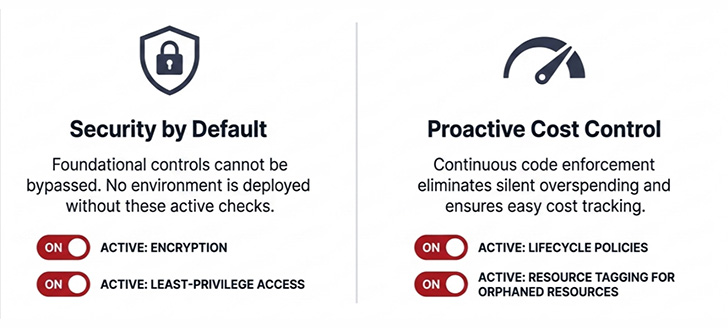
By adopting IaC, the organization automated security and cost management through code-based enforcement.
Encryption and least-privilege access are built into the templates. No environment can be deployed without these controls.
Automated lifecycle policies and mandatory resource tagging ensure orphaned resources are removed and costs are easily tracked.
The organization was able to reduce provisioning time by 91.67% and shorten onboarding from 2 hours to 10 minutes. Adopting a repeatable, auditable infrastructure eliminated manual inconsistencies and reduced error rates.
By deploying automated, code-based enforcement, the organization built compliance into its foundation and strengthened security. These efficiencies reduced operating overhead, enabling the engineering team to focus on strategic growth rather than routine troubleshooting and manual tasks.
This transformation shows how an enterprise can move from a fragmented provisioning model to a fully automated, secure, and cost-efficient infrastructure. By implementing IaC, standardized templates, and CI/CD workflows, the organization reduced onboarding time and improved reliability, governance, and operational functionality. The resulting scalable infrastructure supports rapid business growth while maintaining strong control over security, cost, and performance.