A company moves its aging application to the cloud, breaks it into microservices, and introduces APIs to connect its systems. Deployments become faster, but a few years later, teams are managing dozens of services, hundreds of APIs, and dependencies nobody fully understands.
The technology may be newer, but the complexity can remain.
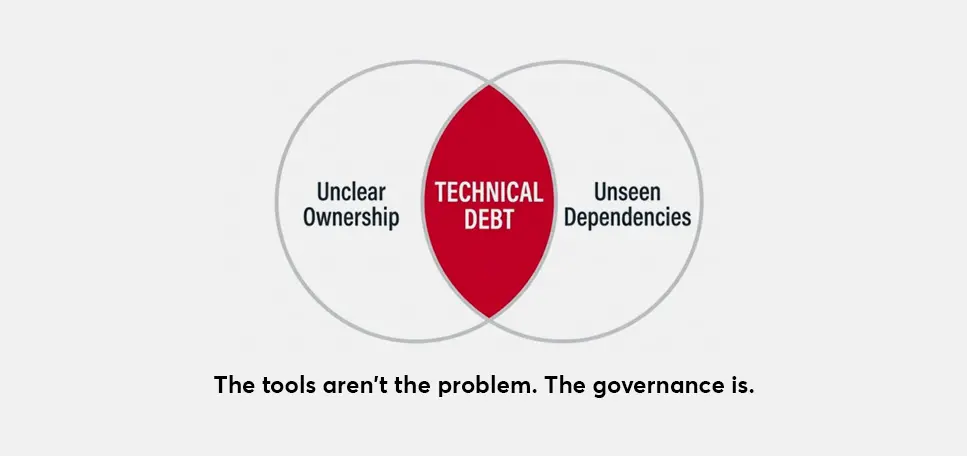
Modernization can remove existing technical debt while introducing new architectural and operational complexity. That complexity is not automatically technical debt. It becomes debt when unclear ownership, unnecessary dependencies, duplicated capabilities, weak standards, or neglected components make future changes harder and more expensive. The real test of modernization is whether the system becomes easier to understand, change, operate, and maintain over time.
Breaking a large application into smaller services lets teams develop and update features independently. But those services still need to work together.
For example: An e-commerce platform might have separate services for orders, payments, inventory, and delivery. If the inventory service changes how it shares stock information, the order service could run into problems if the change isn’t handled properly.
What helps: Split services around clear business capabilities rather than simply breaking a monolith into smaller pieces. Give each service a clear owner, define clear service contracts and manage changes to them carefully, test those interactions, and maintain visibility into dependencies. If most changes still require coordination across several teams and services, the architecture may have changed without reducing the underlying friction.
Not every application needs to be decomposed into microservices. If independent scaling, deployment, or ownership does not provide enough benefit, keeping parts of the system together may be simpler to operate and maintain.
APIs help applications and services exchange data. Problems arise when teams build new ones without checking what’s already available.
For example: A manufacturing company might create separate APIs for supplier data in procurement, inventory, and reporting. If each handles that data differently, a change to supplier information can affect several integrations. Teams may also end up maintaining duplicate features and different security rules.
IBM identifies fragmented API development and decentralized management as contributors to API sprawl.
What helps: Maintain an API catalog that shows what each API does, who owns it, which systems consume it, and its lifecycle status. Define common standards for security, versioning, documentation, and deprecation. Before creating another API, check whether an existing capability can be reused or extended, and retire interfaces that no longer have active consumers.
Cloud migration can improve scalability and flexibility, but cloud environments can also accumulate services, accounts, configurations, permissions, and dependencies that become difficult to understand and operate.
For example: A company may add new cloud services for different applications over several years. Some resources may no longer have clear owners, security configurations may vary between teams, and duplicated tooling may remain in place because nobody is sure whether it is still required.
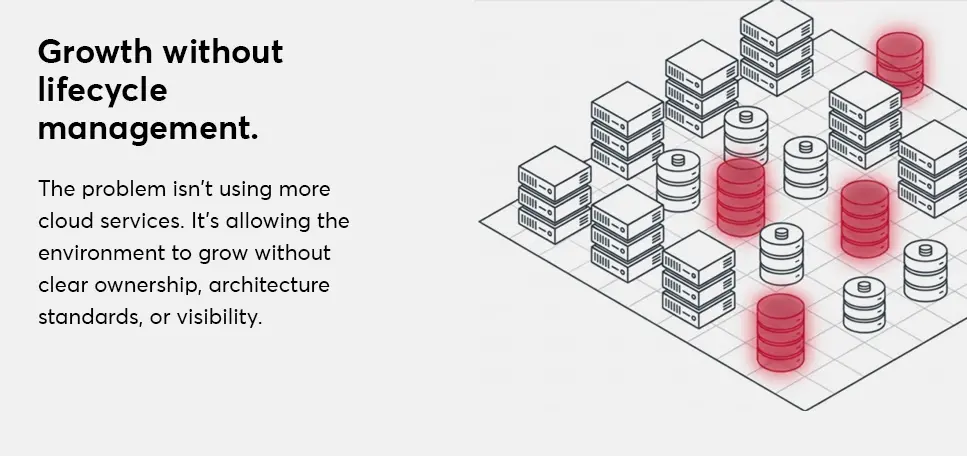
The problem is not using more cloud services. It is allowing the environment to grow without clear ownership, architecture standards, visibility, and lifecycle management.
What helps: Assign ownership to cloud resources and services, standardize common security and operational practices, monitor cost and usage, and regularly review whether resources and tools still serve a business or technical purpose. Remove or consolidate what no longer does.
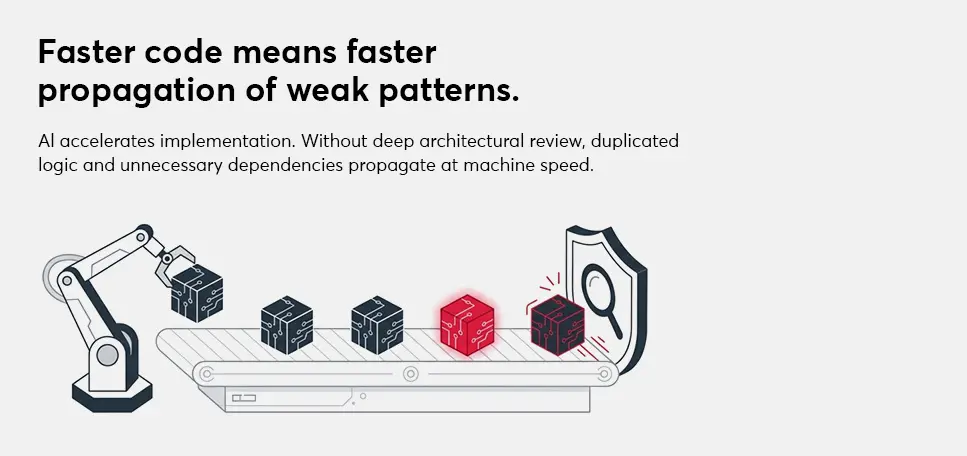
AI-assisted development can accelerate implementation, which means both strong and weak engineering patterns can be repeated more quickly. The risk is not that AI-generated code is inherently poor. It is that duplicated logic, unnecessary dependencies, inconsistent patterns, or missed edge cases can propagate faster when review and testing do not keep pace.
For example: An AI assistant might generate code that duplicates an existing feature, misses an important edge case, or adds an unnecessary dependency. Even if it passes basic tests, it could cause problems when it interacts with other parts of the system.
If developers merge the code without checking it properly, these issues can become harder to fix later.
What helps: Apply the same ownership and quality standards to AI-generated code as manually written code. Require deeper review for architecture, security, data access, database changes, and new dependencies. Treat generated tests as a starting point, and check that they cover real business behavior, edge cases, and failure conditions.
Microservices, APIs, cloud infrastructure, and AI are not the problem by themselves. The problem is adopting them without a plan to manage the complexity they introduce. Preventing new technical debt means looking beyond individual tools and considering how the entire system works together.
Three practices can help:
Before modernization begins, define what should become easier after the change. Then measure whether it actually did. Are changes safer to release? Do fewer teams need to coordinate for routine work? Are recurring incidents decreasing? Can engineers understand dependencies more easily? Is obsolete infrastructure being retired instead of accumulating?
Newer technology is not evidence that technical debt was reduced. Reduced friction in changing, operating, and maintaining the software is.
Technical debt isn’t limited to old code. Even systems built with modern technologies can become difficult to change when responsibilities overlap, services depend too heavily on one another, or teams don’t have a clear picture of how everything connects.
These problems can’t always be fixed by cleaning up code. Teams also need to look at how the system is structured and whether it can keep up with changing business needs.
Modernization should address both the code and the architectural decisions that determine how easily the software can evolve.
Modernize incrementally. Review dependencies, integrations, infrastructure, and architecture regularly, and address areas that are creating measurable friction. Continuous modernization does not mean constantly replacing technology; it means preventing known constraints and obsolete components from accumulating until another large transformation is required.
At InApp, we approach modernization by first identifying what should become easier after the change, whether that is releasing software, integrating systems, understanding dependencies, scaling workloads, or maintaining the application. From there, modernization can focus on the specific constraints creating friction rather than introducing new technology for its own sake.
The goal is simple: build systems that are easier to understand, change, integrate, and maintain.
Technical debt refers to deficiencies, shortcuts, or design decisions that make software harder or more expensive to change and maintain over time. Older technology may contribute to technical debt when it creates real constraints, but age alone does not make software technical debt.
Yes. Modernization can introduce new technical debt when duplicated services, unmanaged APIs, unclear dependencies, inconsistent architecture, or poorly governed infrastructure make future changes and operations harder. New complexity alone is not necessarily technical debt; the issue is whether that complexity creates recurring friction and maintenance cost.
No. Microservices can allow teams to develop, deploy, and scale services independently, but they also introduce distributed-system concerns such as service dependencies, network communication, monitoring, tracing, and operational coordination. Whether they reduce technical debt depends on how well those tradeoffs are managed.
API sprawl occurs when APIs multiply without sufficient visibility, ownership, or governance, making them harder to secure and maintain.
Unreviewed AI-generated code may introduce duplication, inconsistent patterns, or unnecessary dependencies. Testing and code reviews help catch these issues.
Continuous modernization is the ongoing improvement of software through incremental changes, such as updating dependencies, simplifying architecture, and removing obsolete components.