Fielding questions about AI adoption and strategies has become a common activity for leadership teams today. Competitors are continuously announcing AI initiatives, and what are we doing about it? When will AI transform our operations? What will be the AI model? The questions go on. CXOs are caught in a bind with pressure from above to deliver AI-driven ROI, while dealing with legacy systems built for a different era.
The truth is that the success of AI does not start with models or vendors; it starts with legacy software modernization and updating core infrastructure to effectively handle the current AI demands.
This blog specifically describes how you can unlock real business value through strategic software modernization.
We cannot stress enough that the biggest barrier to AI success is not just algorithms, it’s whether your existing systems can support it. Many AI initiatives fail due to this shortcoming and other manual processes. AI flourishes on rapid feedback loops, making predictions, observing outcomes, and continuously refining itself. But many legacy systems operate on batch processing schedules, updating data only overnight or weekly. This inactivity breaks the feedback loop on which AI depends, making it impossible for AI to learn and adapt at the speed modern business demands.
The key insight: Bridging this gap requires smart modernization, and not ripping everything out and rebuilding, but strategically evolving your architecture to support AI to help deliver business value.
The traditional ‘lift-and-shift’ approach is the easiest path to migration, for all you need to do is simply rehost existing applications in the cloud. However, it is the least effective path and delivers the least value. This approach simply does not work.
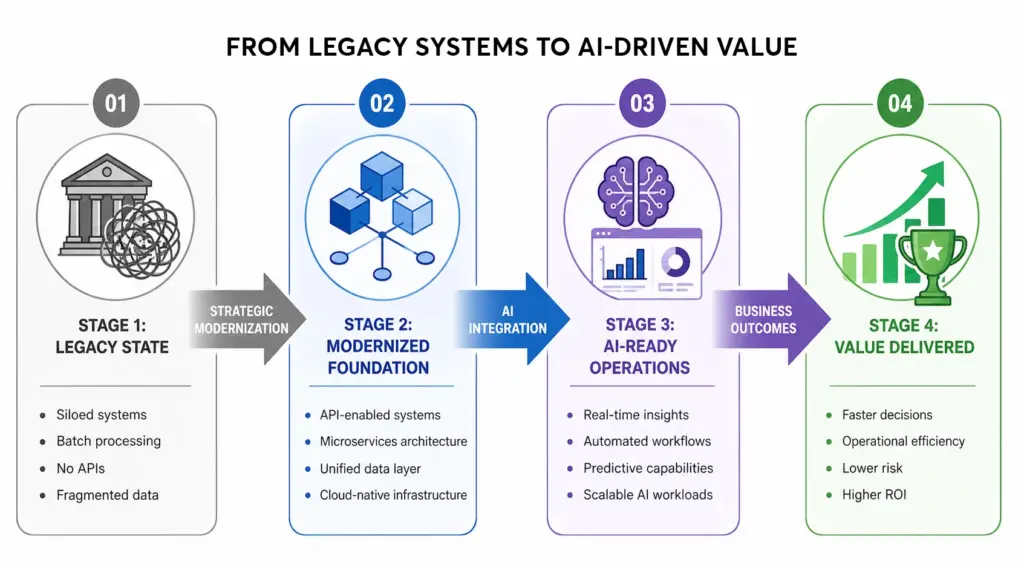
What you really need is an ‘Evolve-and-Enable’ approach. Here, you incrementally modernize specific components of your system, pick high-value pieces to transform first, then rebuild them using modern patterns (API-first, microservices, cloud-native design), and create AI pipelines that enable cloud-native scalability.
Application Programming Interfaces (APIs) are connection points that facilitate different systems communicating with each other, which means that your legacy systems make their data and functionality easily accessible to AI tools that “plug in” and access the business data and functions as and when they need.
Traditional systems are monolithic, meaning they are a single, monolithic application where everything is tangled together. What microservices architecture does is it breaks this into small, independent components, where each component handles one specific function (e.g., payment processing, user authentication, inventory management, etc.). These independent components can be updated, scaled, or even replaced separately without affecting the rest of the system.
This segmentation will help you add AI to a single component (e.g., fraud detection) without rewriting your entire system.
Remember those data silos we talked about earlier in the blog? A data integration layer creates a unified platform that brings together data from all these disparate systems. This could be a data lake (a central repository for all your data) or a data warehouse (organized storage optimized for analysis). When this is done, the AI can now access this unified data layer instead of trying to connect to 10 different legacy systems.
For example, instead of AI needing to look into the CRM, ERP, and e-commerce platform separately, it can access a single data lake that contains information from all three.
Containers (like Docker) are used to package applications with everything they need to run. It makes it easy to deploy applications consistently across environments such as development, testing, production, and the cloud. It also makes version control easier, where you can run multiple versions side-by-side or roll back quickly if something breaks.
For AI, this is crucial because AI models often need specific versions of libraries and dependencies. Containers ensure these dependencies don’t conflict with your existing systems.
The result of all these practices is that your existing systems continue doing what they do well, but they’re now open to AI integration. You haven’t disrupted operations, but you’ve created the pathways for AI to connect and deliver value.
When you modernize systems, data becomes accessible in real time rather than waiting for overnight or days-long batch processes. In fast-moving markets, week-old data is useless. Real-time insights let you spot problems early, identify opportunities quickly (like a viral product trend), and make decisions while they still matter.
It’s like instead of reviewing week-old sales reports, AI provides real-time dashboards showing trends as they happen, enabling faster decision-making.
Connected systems make all the difference. Modernization doesn’t just make individual systems better; it connects them. This connectivity creates data flows that AI can analyze and optimize effortlessly. On the other hand, manual work decreases, error rates drop, and productivity improves.
Cloud-native architecture (built through modernization) is designed to scale up or down automatically based on demand. If you want to add new capabilities to your legacy system, you might have to buy new servers, negotiate with vendors, and do complex capacity planning. Cloud-native systems scale automatically; more demand means more computing power is provisioned automatically, and less demand means you scale down and save costs.
Incremental modernization reduces risk compared to complete system replacements. Because you’re not betting everything on one massive project that could fail catastrophically.
There is a benefit in “fail fast, learn fast”. You are not stuck in a 3-year modernization program before seeing any AI value; you can start delivering value in months.
Yes, modernization creates AI readiness, but most organizations are still in the dark as to where to start. Which systems should we modernize first? What will AI integration actually look like?
InApp’s AI Readiness Sprint offers a structured assessment to help answer these questions. It is a practical, outcome-focused, and time-boxed engagement that delivers specific answers and a concrete roadmap.
Initiate an AI Readiness Sprint: This 6-week engagement does the actual heavy lifting of auditing your systems, identifying what needs modernization, prioritizing based on business impact, and mapping technical changes to business goals.
Instead of CXOs trying to figure this out internally, which would ideally take months (and might miss critical issues), the Sprint provides expert assessment and strategy in 6 weeks.
Review deliverables: When the Sprint concludes, review the deliverables (Readiness Summary, Opportunity & Risk Map, Implementation Blueprint). These documents tell you exactly what’s feasible, what the costs and timelines look like, and what ROI to expect.
Execute incrementally: Based on the roadmap from the Sprint, execute in phased stages. Start with the highest-priority modernization and AI project, prove value, learn lessons, and then move to the next phase. Scale gradually without disrupting ongoing operations.
InApp brings deep expertise in all three required areas: Cloud infrastructure, custom software development, and AI integration. Some would say that specializing in just one area (cloud-only or AI-only) is sufficient, but successful modernization requires expertise across all three.
InApp can work with your existing systems without requiring wholesale replacement or causing any business disruption by just plugging into what you have and evolving it.
AI without modernization might stand for a while, but it won’t last. Smart modernization brings in flexibility, reduces technical debt, and creates the right infrastructure for AI to thrive. But more importantly, it delivers value whether AI becomes your primary competitive advantage or just one tool in your arsenal.
The path forward isn’t about choosing between stability and innovation—it’s about achieving both. Strategic modernization transforms your existing investments into platforms for growth, not obstacles to overcome.
Ready to turn your legacy systems into AI-ready assets?
Get a call-back from an InApp expert.
AI requires real-time data and fast feedback loops to work effectively. Since legacy systems often rely on outdated batch processing, without modernizing them, AI can’t learn or adapt quickly, limiting its business impact.
Lift-and-shift no longer works, which is nothing but just moving your existing apps to the cloud without changing their architecture. It doesn’t unlock cloud-native benefits like scalability, agility, or AI readiness.
Instead of ripping everything out, you modernize incrementally. Pick important components (e.g., customer data platforms), upgrade those with modern architectures (APIs, microservices), and create infrastructure that supports AI pipelines, all without disrupting operations.
Modern systems provide real-time data access for faster decisions, streamline manual workflows for efficiency, and allow cloud-native scalability to save costs and add features quickly, all boosting ROI.